

PLATFORM
Enterprise Protection
from Identity-Based Attacks
Every user connected to your business – from employees to contractors to third parties – represents an entry point for cybercriminals. SpyCloud Enterprise Protection closes identity exposure gaps before attackers can exploit them in ATO, session hijacking, and ransomware attacks.
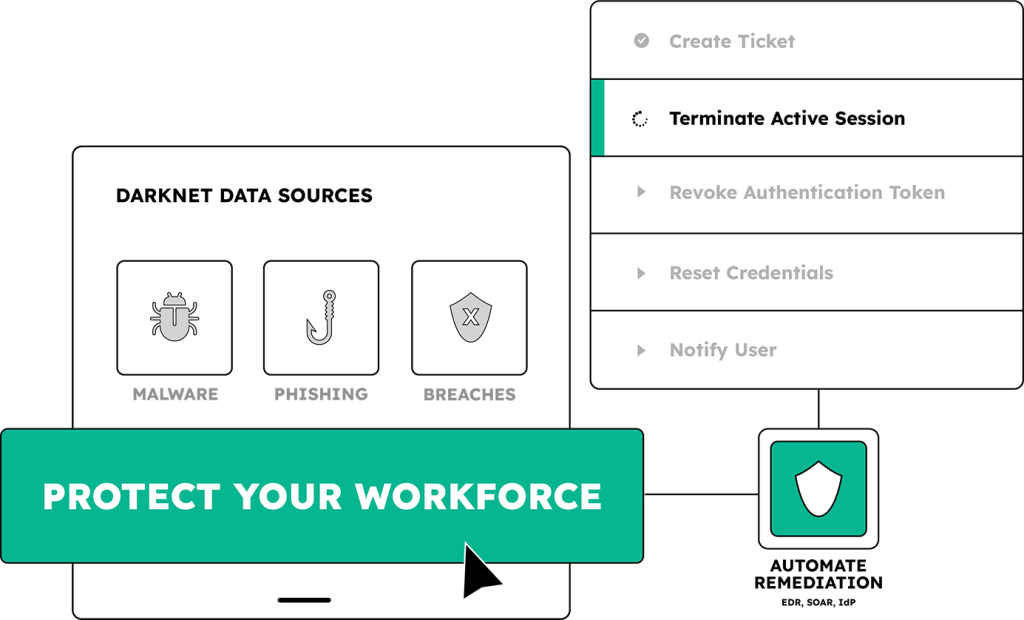
Automated enterprise identity threat protection for overburdened defenders
Continuously monitor for identity exposures stemming from data breaches, malware infections, and phishing campaigns – using the industry’s most comprehensive recaptured data – and take action before bad actors strike.
Get early warning of risks stemming from employees’ holistic exposure history – including personal device infections and credential reuse – that could compromise access to your critical business systems.
Turn high-risk exposures into immediate remediation actions, cutting detection, investigation, and response time from weeks to minutes.
EXPLORE PRODUCTS
SpyCloud Enterprise Protection Products
Don’t just detect identity threats – dismantle them. SpyCloud surfaces exposed identity data across your workforce and automates remediation to block criminals from exploiting it.
Prevent session hijacking from compromised authentication cookies
Act on malware-exposed devices, users, and applications that can lead to ransomware
Monitor supply chain security risks from dark web exposures
We don’t have to do any manual processing of breaches anymore, which took a lot of time with the constant stream of new breaches. SpyCloud allows us to automate the entire process.
EXPLORE WHO USES SPYCLOUD
Defenders
we help
SpyCloud is the trusted partner for security and identity teams who must protect employee identities to secure corporate access.
Security operations
Accelerate detection and remediation of identity threats using SpyCloud with your SIEM, SOAR, and EDR tools
Identity
Identify exposed credentials and password reuse – and remediate exposures within 5 minutes from discovery
Integrations
SpyCloud integrates with your existing security tools and workflows so you can accelerate incident response and shut down hidden entry points. Easily add SpyCloud as a plug-and-play option for identity threat protection with top security vendors: IdPs, EDRs, SOARs, SIEMs, and TIPs.





















Next steps
Start remediating exposed identities in minutes with SpyCloud
Enterprise Threat Protection FAQs
Traditional IAM tools manage access based on what identity providers can see at authentication time — they operate on internal signals from enrolled devices and registered accounts. EDR tools protect managed endpoints but have no visibility into credentials or session artifacts stolen from personal devices, contractor machines, or unmanaged laptops that access corporate applications through a browser. ITDR tools detect anomalous identity behavior after it occurs inside the environment. None of these tools see the criminal underground — where stolen credentials, session cookies, and infostealer malware logs circulate before attackers use them. SpyCloud Enterprise Protection fills that pre-attack visibility gap. By recapturing stolen identity data directly from criminal sources — breaches, infostealer logs, phishing captures, and combolists — and correlating it across an employee’s work and personal identity footprint, SpyCloud surfaces exposures that IAM, EDR, and ITDR tools are architecturally unable to detect. When a match is found, SpyCloud triggers automated remediation — resetting credentials, invalidating session cookies, and closing infected device entry points — within minutes, before attackers can act on the same data.
Attackers don’t limit their targeting to corporate accounts. When an employee reuses a password across a personal email account and their corporate SSO login, a breach of that personal account gives attackers a credential that works inside the corporate environment — and corporate security tools have no visibility into that personal breach. Infostealer malware compounds this further: it frequently infects personal laptops, home machines, and contractor devices that employees use to access corporate applications through a browser. A single malware infection on a personal device can expose an average of 26 business applications, including SSO platforms, security tools, and ticketing systems — none of which appear in a managed endpoint inventory. In 2025, 40% of infostealer infections recorded by SpyCloud occurred on devices with EDR or antivirus tools installed, meaning even managed devices aren’t fully protected. SpyCloud’s IDLink analytics connect work and personal identity footprints, surfacing exposures anywhere in an employee’s digital life that create risk to corporate access — including credentials and session artifacts that account-centric tools never see.
Ransomware attacks rarely begin with encryption — they begin with stolen identity data. The most common ransomware kill chain runs through three stages: an infostealer malware infection exfiltrates credentials and session artifacts from an employee or contractor device; attackers use those artifacts for initial access to corporate applications; lateral movement follows, enabled by the device fingerprints, cookie data, and application credentials captured in the same infection. Nearly one in three companies that suffered a ransomware attack had a prior infostealer infection on record. In 2025, 85% of organizations reported being hit by ransomware in the past year, with 35% of entry points traced to phishing — up from 25% the prior year. SpyCloud Enterprise Protection monitors all three stages of this kill chain simultaneously: credential exposures across breaches, phishing, and malware logs are surfaced for early remediation; device-level infection intelligence identifies the full scope of post-infection compromise before it enables lateral movement; and vendor identity monitoring detects compromised partner credentials before they become backdoor entry points. Interrupting any one of these stages reduces ransomware risk; SpyCloud monitors all three from a single platform.
In traditional security tooling, identity is scoped to a single corporate account — one email address, one directory entry, one set of permissions. A holistic identity view recognizes that every employee has a digital footprint that extends far beyond their corporate account: personal email addresses used to register for services that share a password with work accounts, personal devices that access corporate applications, prior employers whose breach data contains credentials reused at the current organization, and backup accounts tied to the same person. Attackers operate against the full holistic identity. When a breach exposes a personal Gmail address that an employee used to register for a SaaS tool with their work password, attackers can use that credential to access corporate systems — and the corporate security team has no signal that it happened. SpyCloud’s IDLink analytics automatically correlate an employee’s work identity against their broader personal identity footprint, surfacing these cross-account exposure risks that account-centric tools miss. This is why SpyCloud’s IDLink finds, on average, 8 times more identity records per user and 14 times more plaintext passwords compared to native identity provider monitoring — because it’s looking across the full identity, not just the corporate account.
Supply chain identity risk is the exposure path that most enterprise security programs leave unguarded. Vendors, managed service providers, and technology partners all have privileged access to corporate systems — and their own employee credentials, session cookies, and device infections circulate in criminal markets just like those of any other organization. Third-party involvement in breaches doubled year-over-year, from 15% to 30% of incidents. If one of your top five vendors has employee credentials actively traded in criminal markets, that vendor’s compromised identity is a trusted access point into your environment — and a questionnaire-based vendor risk assessment won’t surface it. SpyCloud Enterprise Protection extends identity threat monitoring to an organization’s most critical vendor relationships, continuously tracking each vendor’s Identity Threat Index across four threat signals: breaches, malware infections, phishing campaigns, and combolists. Security teams see which vendor identities are compromised, what was stolen, and when — with 12-month exposure trends showing whether vendor security hygiene is improving or degrading over time. This replaces questionnaire guesswork with continuous, evidence-based supply chain visibility.