

PRODUCT: FINANCIAL THREAT PROTECTION
Detect Stolen Payment Card Data
Before It’s Used for Fraud
Traditional card monitoring only alerts after fraud occurs. SpyCloud provides preemptive protection by detecting compromised credit card data, gift cards, and loyalty cards siphoned from malware-infected devices – giving issuers a chance to act before criminals can.
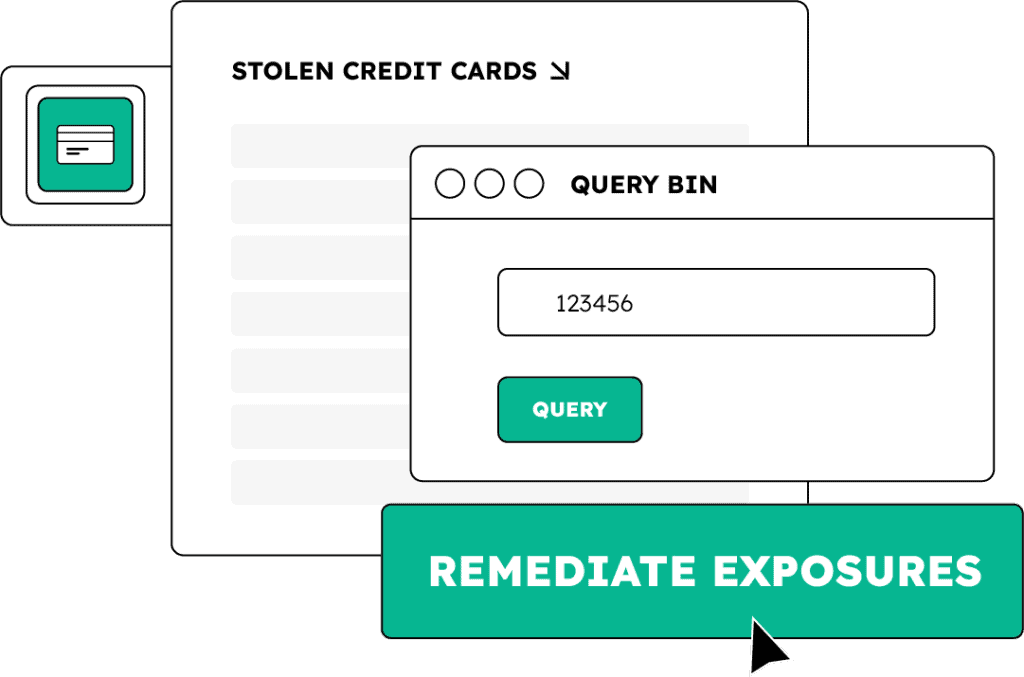
Pre-fraud intelligence to stop payment fraud
Payment card data is commonly harvested through company breaches, infostealer malware on desktops, mobile malware on compromised phones, and phishing infrastructure. These attacks expose far more than just card numbers – often including associated PII such as email addresses, phone numbers, bank account details, and routing numbers.
SpyCloud Financial Threat Protection recaptures this intelligence from millions of infected devices, phishing sites, and breach sources every month, giving card issuers, payment processors, retailers, and fraud teams visibility at the point of exposure – before criminals monetize stolen financial data.
“If your brand is important and you want to protect consumer data, you have to get SpyCloud.”
EXPLORE OTHER PRODUCTS
Get broader fraud protection
Consumer Threat Protection
Cybercrime Investigations
Next steps
Don’t wait for fraud – remediate compromised payment cards with the ultimate pre-fraud solution.
Get a demo today.
Financial Fraud Protection FAQs
Payment card data is harvested through three primary attack vectors. Infostealer malware infects devices and extracts everything stored in the browser, including autofill data that contains saved card numbers, expiration dates, CVVs, and billing addresses. Mobile malware on compromised phones captures card data entered into banking and payment apps. Phishing infrastructure captures card details when consumers are tricked into entering them on fake checkout or banking pages. The resulting stolen records frequently contain far more than the card number itself. A typical compromised card record includes the full PAN, expiration date, CVV, cardholder name, billing address, associated email address, phone number, and in many cases bank account and routing numbers. That additional identity context significantly increases downstream fraud risk because it enables targeted social engineering, new account fraud, and identity-level attacks that go beyond the card transaction. SpyCloud Financial Threat Protection surfaces this full record context, not just the card number, giving fraud teams a richer signal than raw card number lists provide.
Card network fraud telemetry (Visa, Mastercard) and transaction-based fraud detection platforms like Sift and Forter operate on signals generated at the point of a transaction attempt. They detect fraud as it happens or immediately after. SpyCloud Financial Threat Protection operates upstream of that — at the point of exposure, before any fraud attempt has occurred. SpyCloud recaptures stolen card data directly from criminal sources: infostealer malware logs, phishing kit output, and breach data circulating in criminal markets. This intelligence arrives before criminals have had an opportunity to test, sell, or use the stolen cards. Card issuers and fraud teams who monitor their BIN ranges through SpyCloud can identify compromised cards days to months before a fraudulent transaction is attempted, enabling them to block and reissue proactively rather than respond reactively after a chargeback. The two intelligence sources are complementary. Network telemetry and transaction signals catch fraud that slips through. SpyCloud catches the exposure that precedes it.
A Bank Identification Number (BIN) is the first six to eight digits of a payment card number that identify the card issuer and card program. BIN monitoring means querying SpyCloud’s recaptured card data specifically for card numbers whose BIN prefix matches your issued card portfolio. Card issuers and card program owners use BIN-targeted monitoring because they need to identify which of their specific issued cards have been compromised and act on those exposures through their own card management and reissuance workflows. SpyCloud’s targeted BIN query supports up to 10 BINs per API request, returns matching compromised records with card numbers delivered as SHA-1 hashes for secure matching, and is designed for ongoing automated monitoring of issuer-specific portfolios. The full compromised card feed serves a different use case. Payment processors, acquirers, and retailers with store-issued card programs use the full feed to access comprehensive visibility across the exposed card ecosystem without limiting queries to specific BINs. This is the right deployment for organizations that need broad enrichment for risk scoring, analytics, or cross-portfolio exposure analysis rather than targeted issuer-level remediation.
When criminals steal payment card data, they rarely stop at the card number. Infostealer malware and phishing operations capture everything the user submitted or saved: the card details along with the email address, phone number, home address, and in many cases bank account information associated with that card. This associated PII transforms a simple card exposure into a full identity exposure event. A fraudster with both the card number and the cardholder’s email address can attempt account takeover on the card issuer’s portal using credential stuffing, reset the account password, and change the card’s contact information before using it. With the phone number, they can attempt SIM swap fraud to intercept two-factor authentication. With the billing address and email, they can pass identity verification on new account applications. SpyCloud Financial Threat Protection returns associated PII and identity context alongside card records when available, enabling fraud teams to assess the full downstream risk of each compromise rather than treating it as an isolated card event. Organizations that combine Financial Threat Protection with SpyCloud Consumer Threat Protection or IDLink can correlate card exposures to account-level identity risk for a unified view of which customers face the highest combined fraud exposure.
SpyCloud Financial Threat Protection is an intelligence enrichment layer, not a fraud decisioning platform. It does not replace existing fraud engines, card management systems, or transaction monitoring tools. It feeds pre-fraud exposure signals upstream into those systems. The API delivers stolen card intelligence via REST with JSON output, and supports both real-time inline queries and batch processing. Card numbers are returned as SHA-1 hashes by default, with SHA-256 and SHA-512 options available, enabling matching against existing hashed card databases without exposing raw PANs. The data can be ingested into fraud platforms, card management systems, transaction monitoring workflows, or risk scoring models as an enrichment layer. A common deployment pattern is BIN-level monitoring running on a scheduled basis to identify newly compromised cards and trigger automated reissuance workflows in the card management system, while the transaction monitoring platform continues to handle real-time authorization decisioning. Financial Threat Protection also integrates with SpyCloud’s other consumer APIs — Consumer Threat Protection and Session Identity Protection — for organizations that want a unified identity and payment exposure intelligence layer across their fraud prevention program.