USE CASE: THREAT ACTOR ATTRIBUTION
IDENTIFY THREAT ACTORS
with Holistic Identity Correlation
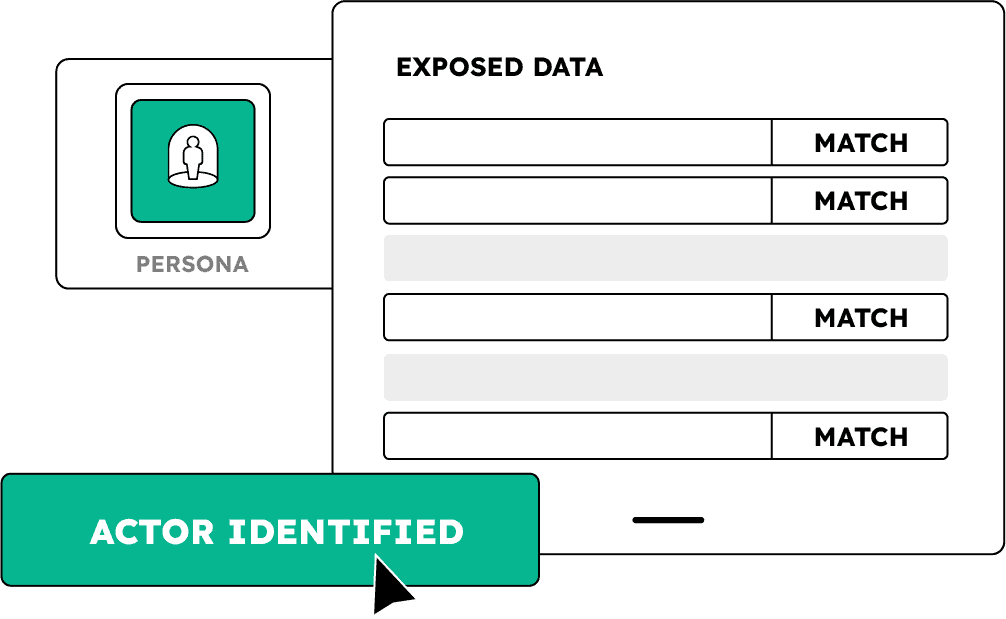
Unmask threat actors with SpyCloud + IDLink™
Begin with any selector – an email, IP, username, or password – and let IDLink trace connections across SpyCloud’s high-efficacy datasets
Turn raw exposure data into holistic, enriched profiles of criminal actors, campaigns, and infrastructure – empowering more analysts to contribute to attribution workflows
Use IDLink to correlate disparate identity fragments – even across TOR, VPNs, or aliases – to reconstruct threat actor personas and expose previously invisible overlaps
EXPLORE PRODUCTS
EXPLORE WHO USES SPYCLOUD
Defenders
we help
SpyCloud powers attribution workflows for teams working to reveal the criminals behind cybercrime – with holistic identity intelligence.
Threat intelligence analysts
Cybercrime units & law enforcement
NEED EXPERT HELP?
We offer analyst services & training
SpyCloud analysts offer tailored methodology training on how to use recaptured digital exhaust for effective pattern-of-life analysis and rapid identification of threat actors.
Integrations





















Threat Actor Attribution FAQs
SpyCloud IDLink automatically pivots from a single submitted selector including email address, username, IP address, phone number, or password hash across SpyCloud’s full recaptured darknet dataset. It surfaces connected usernames, alternate email addresses, shared passwords, device fingerprints, and infrastructure associations linking the target identity to broader criminal activity. Because SpyCloud’s data comes from recaptured infostealer logs, phishing kit output, and breach data rather than surface-web indexing, it surfaces connections that standard OSINT tools do not reach. IDLink surfaces 8 times more identity records per investigation than standard OSINT methods.
Standard OSINT tools query publicly indexed or disclosed data. The criminal underground operates on non-indexed private channels. SpyCloud infiltrates these channels directly, recapturing the actual stolen data rather than indexing what criminals post publicly about it. Over 80% of exposed credentials in SpyCloud’s dataset contain plaintext passwords. In competitive evaluations against Flashpoint, Recorded Future, and SOCRadar, SpyCloud’s plaintext credential depth consistently ends the evaluation.
Manual OSINT pivots historically take days. SpyCloud AI Insights automates the correlation layer: starting from a single selector, AI Insights applies IDLink to surface connected identity assets, pattern-matches across SpyCloud’s recaptured dataset to identify attribution signals, and generates finished intelligence without requiring manual record-by-record review. Customers have reported compressing a two-week investigation to four seconds.
Threat actors frequently reuse credentials, personas, and infrastructure across operations separated by months or years. SpyCloud’s 10-year recaptured data lake catches these reuse patterns that narrower or newer datasets miss entirely. Tracing a threat actor requires correlating device fingerprints, session cookies, malware logs, and credential patterns that link aliases to real identities. IDLink performs this correlation automatically, building the identity graph that connects a current attack to a historical pattern of activity.
SpyCloud Cybercrime Investigations is available as a no-code analyst console and as a programmatic Investigations API. The API integrates natively with Maltego for visual link analysis through more than 80 pre-built Maltego transforms, Splunk for SIEM-embedded enrichment, and Jupyter Notebook for custom analytical workflows. Analysts can pivot directly into SpyCloud’s identity graph from within their existing Maltego investigation workflows without switching tools.