

USE CASE: INSIDER THREAT IDENTIFICATION
Detect hidden insider threats
Insider threats, whether malicious or negligent, can often be tied back to some form of identity misuse. SpyCloud combines decades of investigative tradecraft with AI-powered intelligence to identify employees, vendors, and job candidates who are already compromised, infected, or using stolen identities so your teams can detect insider threats earlier and prevent breaches, data loss, and unauthorized access.
A new and necessary perspective on insider risk
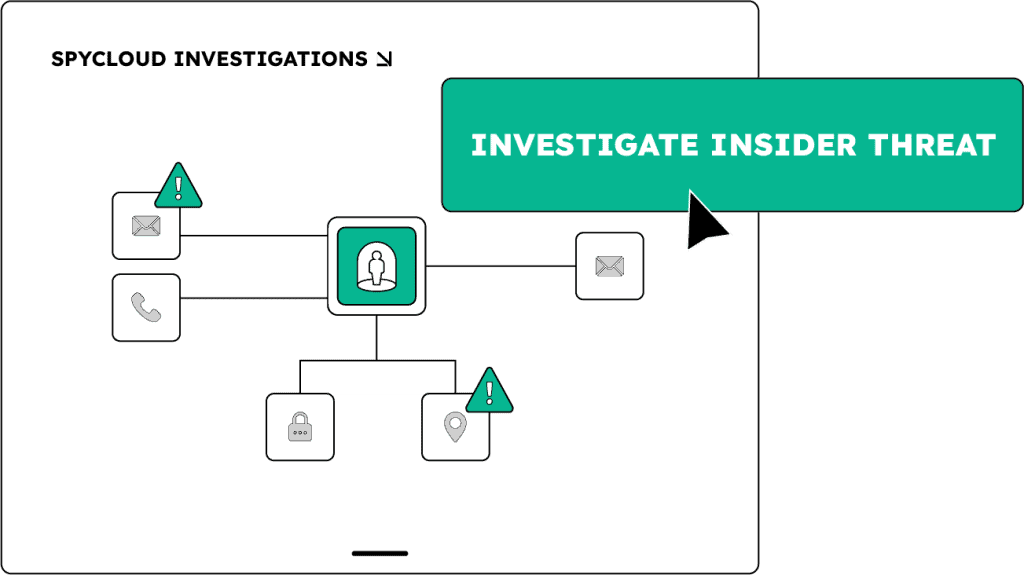
Use AI Insights to surface hidden connections between insiders and criminal infrastructure – revealing adversarial intent before access is abused
EXPLORE PRODUCTS
With SpyCloud Investigations, we found hundreds of accounts on our platform associated with DPRK actors we couldn’t otherwise track, and immediately revoked their access.
EXPLORE WHO USES SPYCLOUD
Defenders
we help
Insider risk & DLP teams
Detect infected or compromised insiders early and act quickly before risk escalates
HR & security teams
SOC & CTI teams
Surface hidden exposures from employees and partners to prevent lateral movement, escalation, and data leakage
Next steps
Discover hidden threats before they become headlines
Insider Threat Detection FAQs
A malicious insider deliberately misuses their access for personal gain, ideological reasons, or to cause harm — selling proprietary data, deleting critical files, or leaking credentials that enable follow-on attacks. A negligent insider puts the organization at risk without intent, typically by falling victim to a phishing attack, reusing weak passwords, or ignoring security policies. A compromised insider is a legitimate employee whose credentials or session tokens have been stolen by an external attacker, who then uses that access while the employee remains unaware. Most behavioral detection tools are designed to catch patterns that emerge after access has been misused, which means all three categories can move through an organization undetected during the window between compromise and detectable behavior. According to SpyCloud’s 2025 Insider Threat Pulse Report, 97% of security professionals express concern about negligent insider threats and 93% about malicious ones. SpyCloud addresses all three categories through darknet intelligence that surfaces identity exposure signals before behavior becomes observable: recaptured malware logs reveal compromised employees, criminal infrastructure correlation reveals malicious insiders, and holistic identity correlation reveals synthetic or fraudulent identity patterns in job candidates.
Malicious insiders often leave a digital trail in the criminal underground before they ever take action inside an organization. An employee who moonlights as a threat actor, who has sold access credentials in criminal markets, or who is operating a fraudulent identity reused from a known criminal persona creates artifacts that appear in breach records, infostealer malware logs, and darknet forums. SpyCloud’s IDLink analytics correlate an employee’s work identity against their full personal digital footprint, surfacing connections to criminal infrastructure that are invisible to behavioral monitoring tools operating inside the corporate environment. When an employee’s personal email address appears in the same infostealer log as malware distribution infrastructure, or when their username appears in a darknet forum associated with credential trafficking, those signals represent adversarial intent that no UEBA tool can generate — because they exist entirely outside the corporate perimeter. SpyCloud AI Insights automates this correlation, summarizing hidden identity connections and surfacing patterns that would take a human analyst hours or days to find manually, compressing the investigation timeline from weeks to seconds.
North Korean IT worker schemes involve operatives who fabricate or steal legitimate identities to apply for remote positions at Western companies, often supported by fake resumes, fabricated work history, and stolen personal information. Traditional background checks do not catch this pattern because the submitted identity elements can appear legitimate in isolation. SpyCloud approaches this problem from the darknet side. IDLink correlates the identity artifacts submitted during a job application — email addresses, usernames, phone numbers, professional history — against SpyCloud’s recaptured dataset of breach records, malware logs, and criminal market activity. When those identity elements appear in combinations inconsistent with a legitimate biography, or when they correlate with known adversarial infrastructure, fraudulent accounts, or prior criminal activity, SpyCloud surfaces that signal before the candidate is onboarded. One customer, a professional networking platform, reported finding hundreds of accounts associated with DPRK actors using SpyCloud Investigations and immediately revoking their access. SpyCloud’s blog post on identifying fake North Korean IT workers details the specific investigative methodology used in this detection. According to Charles Carmakal, CTO of Mandiant Consulting, nearly every CISO he has spoken to about the North Korean IT worker problem has admitted to hiring at least one North Korean IT worker.
Behavioral detection tools analyze what users do inside the corporate environment — access patterns, data movement, login anomalies, and policy violations. They are reactive by design: they generate alerts only after observable behavior has occurred, which means the detection window opens after an insider has already begun acting. The most dangerous insider threat scenarios involve actors who behave normally for extended periods before taking action, or who exploit trusted access in ways that fall within normal usage parameters. SpyCloud’s Insider Threat Pulse Report found that 67% of security teams are planning to augment their insider threat programs in the next 12 months, signaling widespread recognition that existing tools are insufficient. The gap behavioral tools cannot close is what happened to a user before they joined the organization or outside the corporate perimeter during their tenure. A compromised employee whose device was infected by infostealer malware last week has not yet exhibited any anomalous behavior. A malicious insider who has been planning data exfiltration for months may exhibit no behavioral signal until the moment of action. SpyCloud surfaces the pre-behavioral evidence: recaptured darknet data that shows credential compromise, criminal infrastructure ties, or synthetic identity patterns that precede detectable behavior by days, weeks, or months.
SpyCloud’s Insider Threat Pulse Report found that 87% of organizations already involve their HR or recruiting teams in insider threat defense, but 60% do so through manual, ad-hoc processes with no automated workflows linking HR and security systems. SpyCloud enables structured collaboration across three lifecycle stages. At pre-hire screening, SpyCloud Investigations allows security or HR teams to run candidate identity correlation against SpyCloud’s recaptured darknet dataset to surface fraudulent identities, criminal infrastructure connections, or synthetic identity patterns before an offer is extended. This is particularly relevant for roles with privileged access and for remote positions where in-person verification is not possible. During employment, Workforce Threat Protection and Endpoint Threat Protection continuously monitor employee credentials and device telemetry for signs of compromise, surfacing newly exposed credentials or malware infections to security teams who can act before an external attacker exploits the compromised account. SpyCloud’s API and SOAR integrations allow these signals to route automatically into insider risk case management systems or HR ticketing workflows rather than remaining siloed in the security stack. At offboarding, SpyCloud can identify whether a departing employee’s credentials or access artifacts are currently circulating in criminal markets, enabling targeted revocation and access review rather than a blanket checklist.