

USE CASE: VENDOR RISK DETECTION
DETECT VENDOR RISK
& Prevent Supply Chain Threats
Your attack surface includes any and every identity that is connected to your systems. When those identities fall victim to phishing, malware, or breaches, they become high-impact entry points for attackers.
SpyCloud adds a new layer to vendor risk detection: evidence-based exposure data that reveals which vendors are compromised, how they were exposed, and when it happened – not just risk scores.
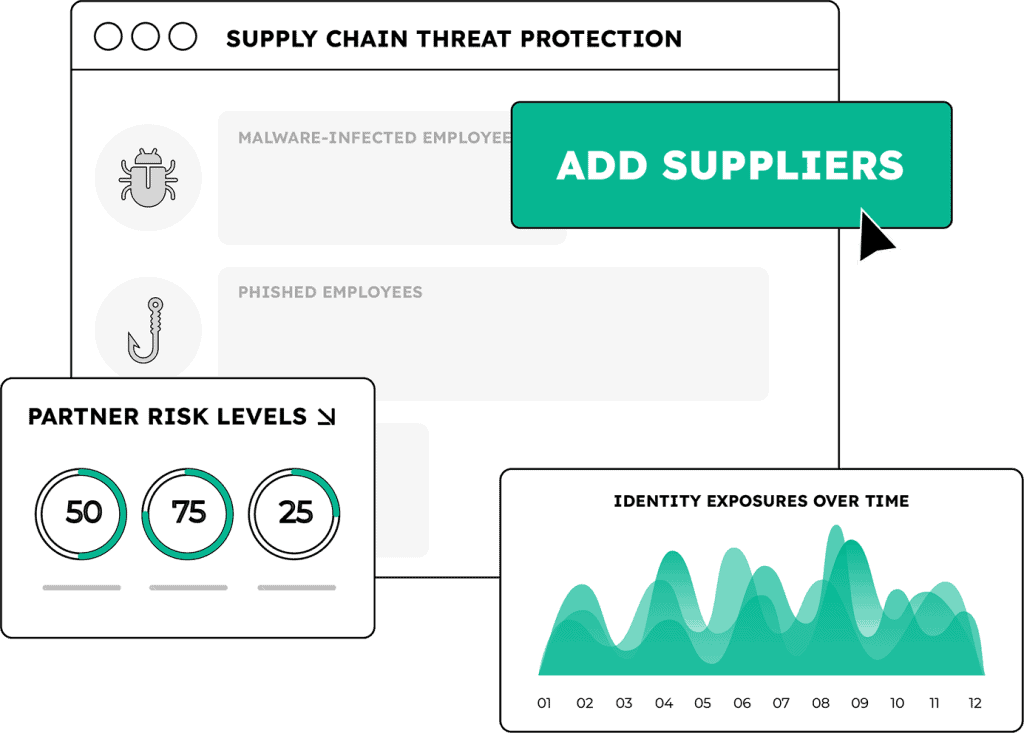
Detect compromised vendors your risk tools miss
Most vendor risk tools rely on audits, questionnaires, and static scores. But they can’t tell you who’s compromised or when it happened.
SpyCloud continuously monitors the criminal underground, surfacing stolen credentials, malware-infected devices, and phishing exposures tied to your critical suppliers and partners.
The result: a clear picture of supply chain threats and their impact on vendor risk.
Continuously monitor third-party identity exposures across billions of identity records from breaches, malware logs, phishing kits, and combolists.
EXPLORE PRODUCTS
Extend identity threat protection beyond your perimeter
Shut down account takeover threats by revoking access or rotating exposed credentials
EXPLORE WHO USES SPYCLOUD
Defenders
we help
SECOPS
Detect when compromised vendor identities pose a threat to your environment and respond with evidence-based intelligence
CISOS
Bridge the gap between compliance and real-world threats with a new layer of protection for your vendor risk program
Vendor Risk Management
Strengthen procurement and review processes with visibility into vendor identity exposures with factual data
Next steps
Supply Chain Vendor Identity Risk FAQs
Traditional VRM and TPRM platforms measure vendor security posture through questionnaires, web asset scans, and point-in-time assessments. These approaches cannot detect whether vendor employee credentials are actively circulating in criminal markets. Third-party involvement in breaches doubled year over year from 15% to 30% of incidents, and the attack path in most cases is compromised identity data that gave attackers trusted access. SpyCloud monitors vendor employee domains against recaptured breach records, infostealer malware logs, phishing captures, and combolists continuously.
The Identity Threat Index is SpyCloud’s composite risk score for each monitored vendor, calculated from the volume, recency, and source type of identity exposures detected across that vendor’s employee domains. It combines signals across four threat categories: credential breaches, infostealer malware infections, phishing campaign captures, and combolists. Tracking the index over time shows whether a vendor’s security hygiene is improving or degrading, enabling pre-incident triage of which vendors are trending toward elevated risk.
Vendors typically have privileged or trusted access to enterprise applications, shared infrastructure, or SSO-federated systems. When a vendor employee’s credentials are stolen through infostealer malware, phishing, or a third-party breach, those credentials may provide direct access to the same applications the vendor uses to serve the enterprise. SpyCloud surfaces compromised vendor identities along with the exposed applications recorded in infostealer malware logs, showing which applications a vendor employee accessed from an infected device and whether any are shared with the enterprise environment.
SpyCloud monitors vendor employee domains across four exposure sources: credential breaches, infostealer malware logs, phishing campaign captures, and combolists. Standard dark web monitoring scans indexable portions of darknet forums for mentions of email addresses or domains. SpyCloud recaptures the underlying data directly from criminal sources, surfacing infostealer log data and phishing kit output that never appear in searchable dark web forums. This produces significantly broader coverage for the malware and phishing vectors that are the primary supply chain attack paths today.
SpyCloud supports a vendor access model that allows enterprise customers to grant vendors visibility into their own exposure data without surfacing the broader enterprise monitoring context. Vendors who can see their own exposure data can take direct action including forcing password resets for affected employees, investigating infected devices, and validating that the exposure path into the enterprise has been closed. This turns one-sided security posture assessments into evidence-based security partnerships.