This October was a pretty spooky time in the cybercrime underground.
This month, we will cover:
- The disruption of a major bulletproof hoster causing ripple effects across the ecosystem,
- An update to Remus stealer targeted at taking over Gmail accounts,
- A Palo-Alto targeted exploitation campaign, and
- Updates to the iAuthFlow phishing template.
Let’s get into it!
Dispatch from the Forum Wars: the Virtualine disruption
Virtualine Disruption
On October 27, a group of international law enforcement partners seized the domain for Virtualine – one of the most prolific bulletproof hosting (BPH) providers used by cybercriminals around the world. Virtualine also used the brand names Omegatech, Spamhouse, Lanedo, Secury, and Massgod. BPH providers offer web hosting services while intentionally ignoring abuse complaints, resisting law enforcement intervention, and shielding their customers from legal process, in order to provide reliable hosting for cybercriminals.
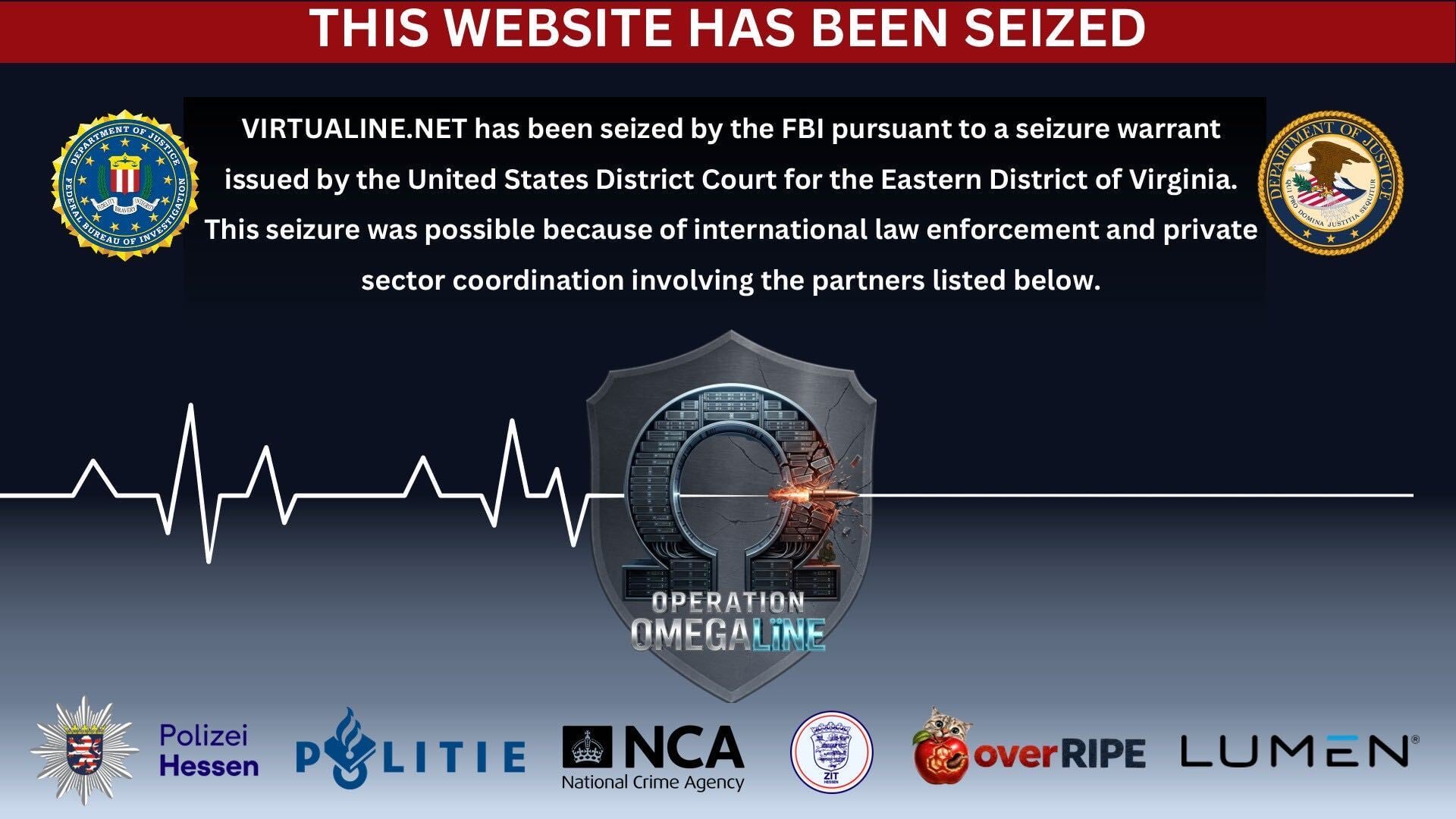
Virtualine domain seizure splash page.
Coinciding with this seizure, we observed likely related website service disruptions across a variety of categories of cybercrime that we track, including phishing kit panels, dedicated leak sites (DLS) for ransomware gangs, and criminal forums. Disruptions of centralized cybercrime enablement services (like Virtualine) can have ripple effects across the cybercriminal ecosystem – forcing other threat actors to have to scramble to recover from the loss of service.
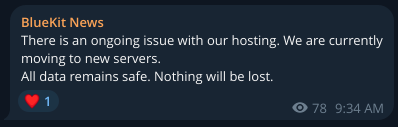
Telegram announcement from the BlueKit phishing kit developers about a hosting service disruption that they experienced around the time of the Virtualine takedown.
A DarkForums Copycat
DarkForums – a popular English language criminal forum – was one of the sites that appeared to have been impacted by the Virtualine disruption. In the relatively brief time period that DarkForums was down, a copycat site popped up at darkforums[.]team. Some darknet watchers alleged that this copycat was targeted at phishing DarkForums account credentials. Both the real and the copycat versions of DarkForums are currently online at the time of writing. However, while the real DarkForums recently underwent a redesign (essentially just changing their accent color to green), the imposter site still has their previous site design style – itself a copy of the original RaidForums.
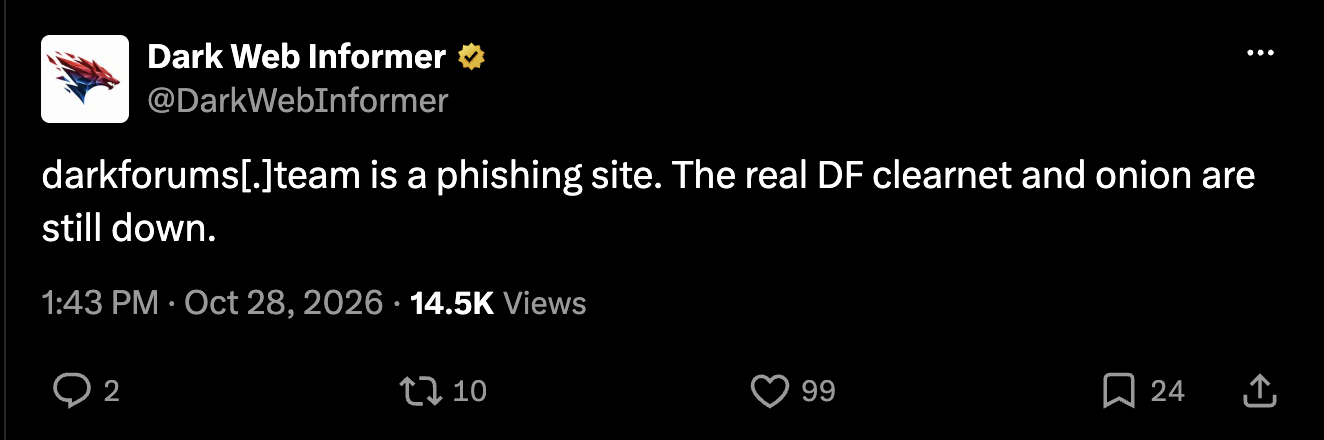
X post by Dark Web Informer alleging that darkforums[.]team is a phishing site.
DarkForums homepage after their green redesign.
Remus infostealer targeting Gmail account access
Remus – a popular commodity infostealer malware – recently came out with a new feature to gain persistent Gmail account access. Researchers at HudsonRock first wrote about this new feature, after the Remus developers posted an announcement that their stealer could now compromise Google mailbox accounts and maintain persistent access that survives even password reset and session revocation. The sales announcement advertises the new capability within their “enterprise” tier, a tier whose subscription costs $1,000 per month. They describe the capability as leveraging a “zero-day” vulnerability in Gmail that will allow users to intercept one-time codes without using cookies.
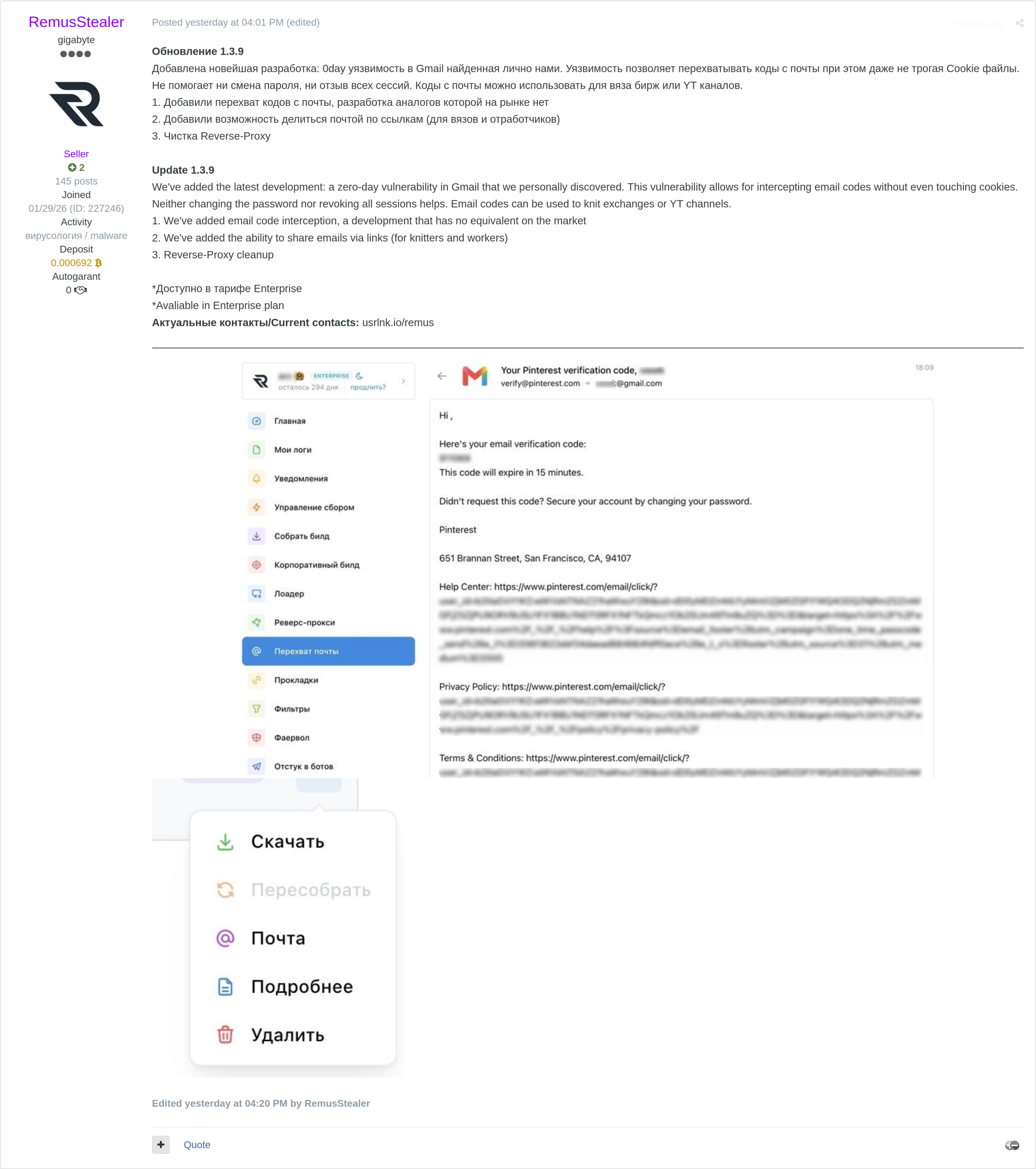
A post by RemusStealer on the Russian cybercrime forum Exploit describing the new capability.
SpyCloud Labs has not observed evidence of this capability being used within any Remus infostealer logs as of the time of writing. Based purely off of the actors’ claims, we judge that this capability is unlikely to be an actual zero-day exploit against Gmail, as claimed. Instead, it is possible that the Remus panel is functioning similar to modern phishing kits, like BlueKit, which register an attacker-controlled MFA after confirming access via a stolen session. This is a reliable form of persistence as it survives both password reset and session revocation; you can only remove their access by specifically unenrolling the attacker-controlled MFA method. However, we wouldn’t really classify it as a zero-day vulnerability – it’s more like an authenticated user being able to manipulate account settings in ways that are somewhat opaque to understand for regular users and defenders.
SpyCloud Labs will follow this development and report back when we have more information about this alleged “vulnerability” in Gmail.
PHP2Shell Arsenal
On November 5, 2026, Hunt.io documented an open directory on port 8080 of a Tokyo VPS at 130.94.67[.]235 holding a working PAN-OS exploitation toolkit (PAN-OS is the software in Palo Alto Networks firewalls). SpyCloud Labs obtained a copy of the same file server and performed an analysis of its contents which included scan results, exploitation logs, and configuration-mining output from exploitation attempts directed at vulnerable web servers.
The operator left evidence of their PAN-OS hacking pipeline recorded end to end. They started with a 19,182-row list of candidate PAN-OS management interfaces. A fingerprinting pass confirmed a PAN-OS version number on 4,590 of them; the next step confirmed that 631 of those ran the 12.x firmware that the exploit chain covered. Then, the operator selected 240 endpoints, and was able to root 24 of them across three successive waves. The toolkit only appears to have supported the 12.x branch, which ships with PHP 8.0.30. Its README documentation explicitly marks 11.1.6 as unsupported by the toolkit, because the exploit was never calibrated for that version’s PHP 7.4.33 runtime, and 11.1.6 was the most common version among the fingerprinted hosts, accounting for 1,223 of the 4,590. That conversion rate is fairly low: 24 appliances out of 19,182 is only 0.125%. The successful attempts took between 7.9 and 29.9 minutes each.
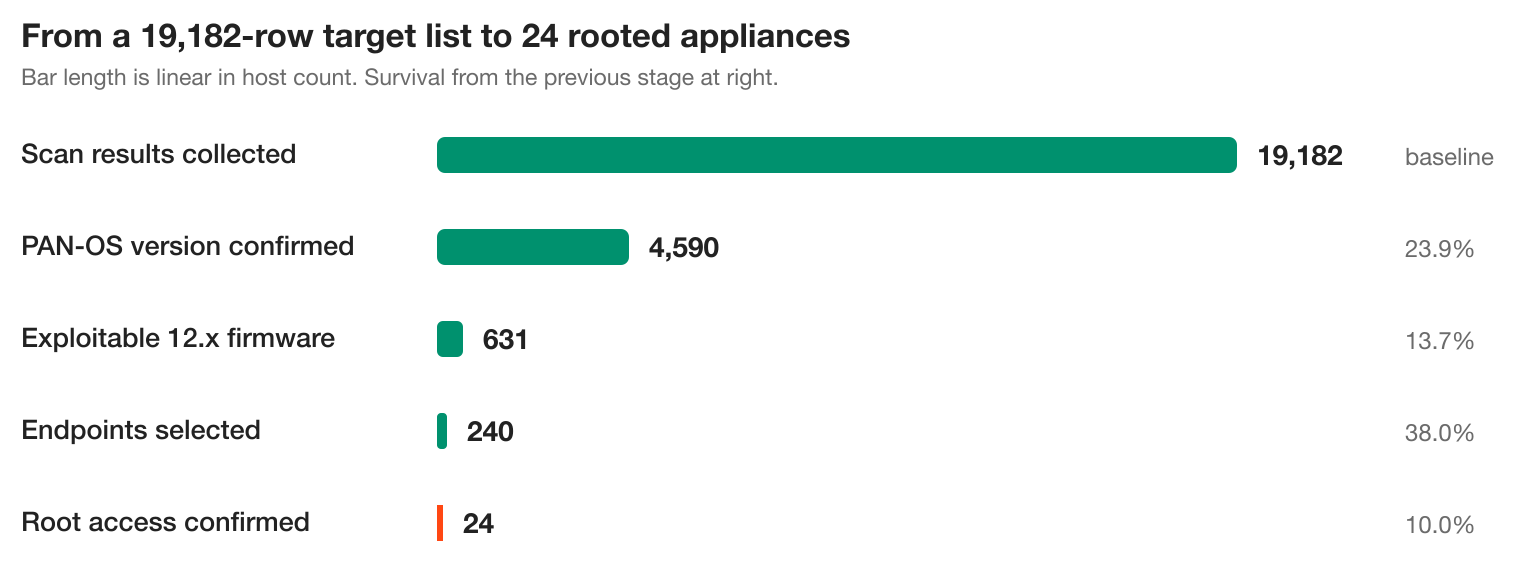
Process flow showing how the threat actors went from a scan showing almost 20,000 internet-facing Palo Alto appliances, all the way to 24 compromised devices.
Out of the 24 rooted endpoints, 18 were hosted in the United States and the other 6 were hosted in South Korea. The majority were hosted on cloud hosting or colocation infrastructure like Azure and AWS. A twenty-fifth appliance, a Panorama management server, also appears to have been compromised using this attacker infrastructure, but it was accessed over an internal reverse tunnel rather than from the target list, and isn’t included in the original appliance scan data.
Only three compromised organizations can be loosely identified because their targeted appliances carried a domain or certificate: a US defense-sector organization, a Mexican financial institution whose appliance presents a wildcard certificate for its corporate domain, and a likely managed security service provider (whose firewall certificate carries the hostname mssp-fw-01). The other 21 appliances have default self-signed PAN-OS certificates whose common name is the appliance’s serial number, so the scan data carries no owner for them at all. The three organizations we could identify still appear to share no sector, no country and no hosting provider, and the only selection criteria we can discern are firmware version and region. Only the US defense-sector organization has strong evidence of post-explotation lateral movement – the Panorama management server (the twenty-fifth appliance mentioned above) is also on that same network.
We see activity on the box dating back over a year, to well before the PAN-OS exploitation activity. The only files vim ever touched on it are system configuration, in two sessions sixteen months apart. On June 23, 2025 the operator edited the network configuration and /etc/security/limits.conf, where the open-file ceiling governs how many concurrent connections a scanner can hold (the PAN-OS scanning later ran at 200 workers). On March 30, 2026 they edited the cloud-init files that disable network reconfiguration at boot.
iAuthFlow adds Gmail filter control and per-session VPN support
iAuthFlow is a Browser-in-the-Middle (BitM) phishing system with multi-account support, proxy awareness and control through Telegram. Its developer, who goes by the moniker PHISHLETS, advertises their tool on Exploit, a high-end Russian language criminal underground focus focussing on malware. The PHISHLETS account dates from June 2024, has 495 posts and holds a forum deposit.
Researchers from Abnormal published an analysis of the iAuthFlow V2 kit back in August, noting that the kit allowed phishers to enroll an operator-controlled passkey that survived password reset attempts and session revocation. Their research examined a Google-targeted build, but they noted that the seller also advertised versions for Microsoft, iCloud and LinkedIn. That research, also based on the seller’s posts, gives a base price of $10,000 for the toolkit, with further modules sold separately.
What is a Phishlet?
Phishlet – the term that the PHISHLETS moniker is referencing – is a configuration template for an adversary-in-the-middle (AiTM) phishing framework (like Evilginx or iAuthFlow). Each phishlet tells the attacker’s proxy how to relay a login for a specific service, like Microsoft 365 or Google, including which real login page to send traffic to and which session cookies and tokens to capture. So a given AiTM phishing framework will have multiple phishlet templates for the most popular real services that phishers want to imitate.
Tool update on November 2: Gmail filter manager
On November 2, PHISHLETS updated their tool, adding a feature enabling an operator to build out a library of custom Gmail filter rules by sender, recipient, subject, attachment, message size or custom query. Available actions are label, archive, mark as read, star, never send to spam, and delete. The kit creates the filters in the victim’s account automatically after each successful session, or on demand.
The seller’s own screenshot shows a rule that deletes mail from Google’s account-notification address. This feature is likely intended to hide security alerts from the victim and to divert selected mail, such as invoices or password resets, with no visible change to the inbox. This feature can allow an attacker to remain inside an account for longer periods of time without the victim ever noticing anything is amiss.
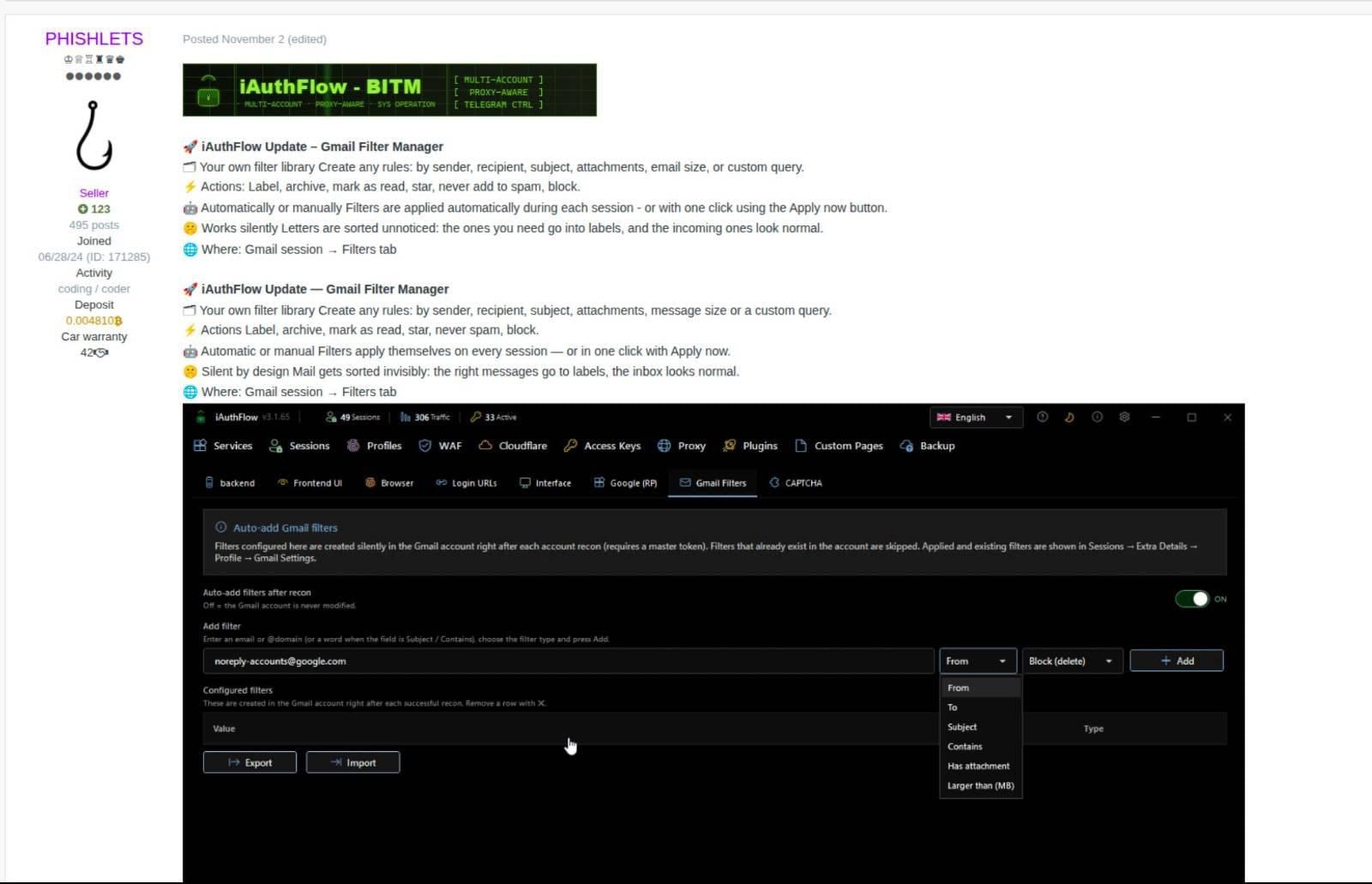
The November 2 post by PHISHLETS announcing the iAuthFlow Gmail Filter Manager.
Tool update on November 9: built-in VPN support
On November 9, PHISHLETS posted about an additional feature addition: now each hijacked session runs through its own VPN tunnel with its own IP address and country. Operators can add accounts from commercial providers (like NordVPN, Mullvad, PIA and IVPN). The kit selects an exit server that matches the victim profile’s location and fails over automatically if a server is blocked.
The seller states that location, IP, and language align with the browser fingerprint so that “Google and Microsoft see a consistent identity.” This appears to be designed to defeat impossible-travel alerts and location-based risk scoring.
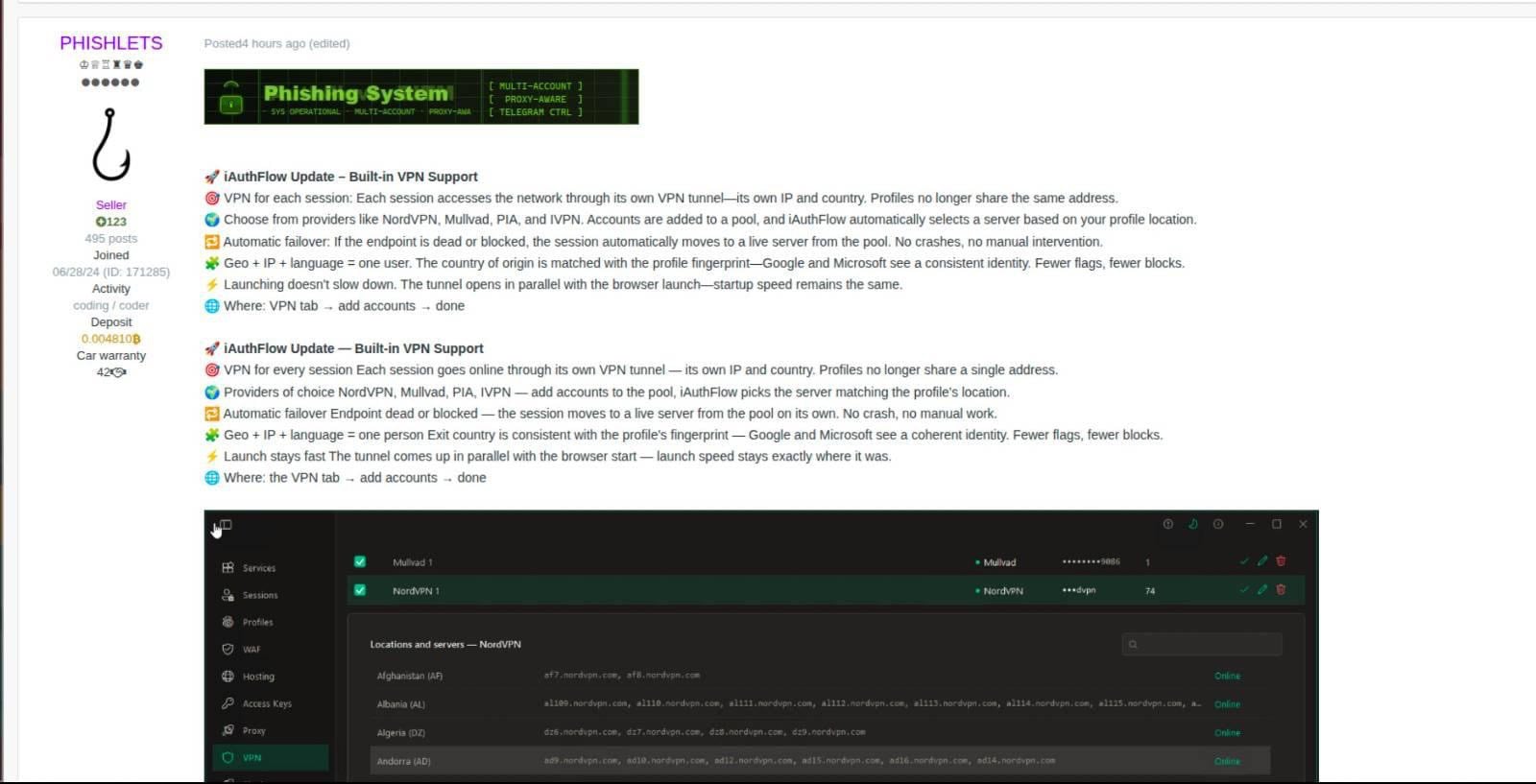
The November 9 post by PHISHLETS announcing built-in VPN support.
Other research insights from SpyCloud Labs
A resale market now prices stolen AI access at up to 91% below list, and these tokens can outlast a password reset, so defenders need to rotate them after any infostealer infection on a developer’s machine.
Recaptured data numbers for October 2026
October monthly total
Total New Recaptured Data Records for October:
4,139,552,968
New Cookie, Session Token, and Authentication Access Records:
1,899,425,702
New third-party breach data this month
Third-Party Breaches Parsed and Ingested:
6,586
New recaptured phished data this month
New Phished Data Records:
105,429,506
New infostealer malware data this month
Stealer Logs Parsed and Ingested:
6,811,880
New Data Records from Stealer Infections:
203,582,768
Discover what cybercriminals know about your business and your customers – and how to prevent targeted attacks with SpyCloud.
Keep reading