

USE CASE: PHISHING EXPOSURE REMEDIATION
Remediate Phished Identities
When phishing works, we make it worthless
New phishing research:
Enterprises 5X more targeted by phishes than malware →
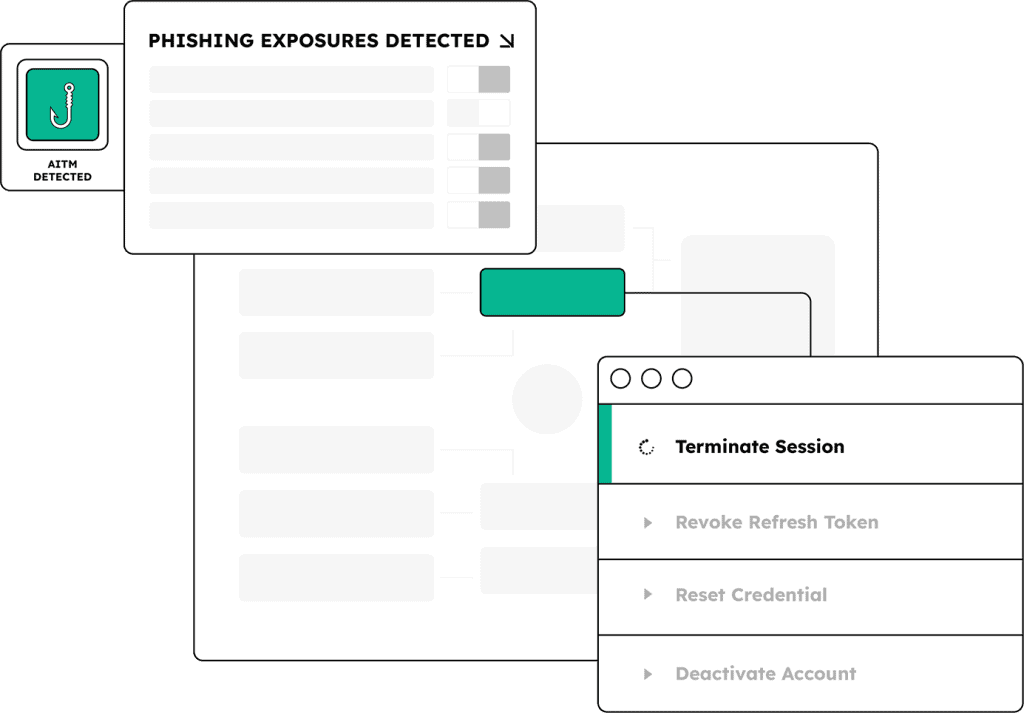
Avoid phish fallout with identity threat protection
Reset passwords or trigger enhanced authentication before attackers weaponize phished credentials
Remediate phished employee and customer identities automatically via native integrations or by kicking off a workflow in your SOAR, IAM, or fraud detection platform
Zero in on exposed users who appear on phishing target lists so you can monitor, educate, or take other appropriate steps in advance
EXPLORE PRODUCTS
Illuminate the phish – and erase the exposure with SpyCloud
EXPLORE WHO USES SPYCLOUD
Defenders
we help
Next steps
Phishing Exposure Remediation FAQs
Breach-exposed credentials appear in published datasets with known breach dates, giving security teams a structured notification path. Phishing-exposed credentials are captured in real time by phishing kit infrastructure, distributed through criminal channels immediately, and used within hours or days before they ever appear in a breach notification service. In 2025, phishing attacks surged 400% year over year and SpyCloud recaptured 28.6 million phished identity records including session cookies and authentication tokens captured mid-authentication by AitM phishing kits. Without a mechanism to detect phishing kit output directly, security teams have no way to know which employees were victimized until an attack succeeds.
Adversary-in-the-middle phishing kits proxy the entire authentication process. When an employee authenticates through the phishing proxy, the kit captures their credentials and critically the session cookie and refresh token the legitimate server issues after authentication succeeds. These post-authentication artifacts are more dangerous than the password because they bypass all subsequent login controls including MFA and passkeys. SpyCloud infiltrates AitM phishing operations directly, recapturing the harvested session artifacts from criminal infrastructure within hours of the original phishing event.
SpyCloud monitors domains and email addresses against its continuously updated recaptured phishing dataset. When a phishing campaign captures credentials tied to a customer’s domain, SpyCloud surfaces the affected employee identities, the specific credentials and session artifacts stolen, and the phishing source metadata. This allows security teams to scope remediation precisely: forced password resets and session revocations only for confirmed phishing victims rather than a blanket organization-wide reset that creates operational disruption without proportionate security benefit.
Phishing overtook all other attack vectors as the leading ransomware entry point in 2025, accounting for 35% of ransomware incidents, up from 25% in 2024. The attack chain runs from successful phishing capture of employee credentials, to criminal market sale, to ransomware operator acquisition, to lateral movement and encryption. The window between phishing capture and ransomware deployment can be hours. SpyCloud recaptures phishing kit output before the stolen artifacts reach criminal markets, enabling remediation in the same window that would otherwise be used for initial access.
Password resets close the credential-based access path but do not address the session artifacts that AitM phishing also captures. A refresh token stolen by an AitM phishing kit remains valid for up to 90 days in most enterprise identity provider configurations, regardless of any subsequent password change. An attacker holding a stolen refresh token can silently mint new session cookies throughout that window. Full phishing remediation requires revoking the stolen refresh token and terminating the IdP-level SSO session in addition to resetting the password. SpyCloud surfaces all three stolen artifact types and signals the identity provider to execute all three remediation actions.