

RESOURCE HUB
PHISHING
IDENTITY EXPOSURE:
What Attackers
Steal
And How To Shut It Down
THE ENTERPRISE PHISHING THREAT
PHISHING TARGETS THE ENTERPRISE
5x
42%
94%
AND OPENS THE DOOR TO RANSOMWARE
39%
2x
corporate credentials are twice as likely to be phished compared to consumer accounts
47%
of the FTSE 100 had employee data exposed by successful phishing attacks in the last 12 months
Inside the path from phish to full identity attack
INTERACTIVE
After a phishing attack
After a successful phishing attack, a stolen password is the least valuable thing taken. Phishing kits capture session cookies, authentication tokens, MFA codes, and credentials.
A password reset addresses the credential. It doesn’t reliably revoke the session cookie or refresh token issued alongside it, and 58% of security teams say they struggle to identify which credentials or tokens a phish exposed.
SpyCloud recaptured 28.6 million phished identity records last year. A match against your domain shows which identity was compromised and needs to be remediated, including a refresh token that would otherwise keep issuing access.
What MFA and password resets miss
PREVENTION
Phishing takes the session as it's issued
A victim signs in through a reverse proxy sitting between them and a real service. AitM passes the MFA challenge straight through and takes the session in the same motion, so no control sees a bypass. Push, SMS, and OTP codes relay cleanly. Phishing-resistant MFA stops this relay, which is why kits have shifted to device code phishing and browser-in-the-middle.
62%
of phishing attempts Microsoft blocked by mid-2025 came from Tycoon 2FA, an AitM kit
PHISH-RESISTANT MFA
Passkeys don’t stop device code phishing
FIDO2 security keys and passkeys stop a phish from relaying a login through a fake page, and CISA calls phishing-resistant MFA the most secure form of MFA. Device code phishing sidesteps that relay entirely. The victim enters an attacker-generated code on Microsoft’s real sign-in page, and Microsoft issues fresh tokens directly to the attacker’s device, since origin binding never applies to a real domain.
99%
REMEDIATION
The artifacts outlive the password
A password reset invalidates the credential. It doesn’t reliably revoke the session cookie or refresh token issued at sign-in. In most IdPs, tokens from passwordless sign-in, tokens issued to confidential clients, and sessions at downstream apps stay valid until your team revokes them.
90 days
Phishing operations
Phish kits we track
Total phish kits tracked
One of the most prevalent phishing-as-a-service kits
Tycoon 2FA
Proxies real Microsoft 365 and Google Workspace logins to capture session cookies, MFA codes, and credentials. SpyCloud identified 328,865 victim records exposed through Tycoon 2FA’s administrative panels, about 80% tied to enterprise-managed email domains, before Europol and Microsoft disrupted its infrastructure in March 2026.
- Victim opens the proxied login page.
- Kit relays credentials and the MFA challenge to the real service.
- Kit lifts the session cookie from the response in real time.
Fastest to adapt
Kali365, now under ‘Octopus’ branding
Kali365 runs two MFA-bypass methods in parallel, device code phishing and AiTM cookie theft, per SpyCloud’s tracking. After an FBI bulletin named it, the kit announced its own retirement, then kept operating as Green or Black Octopus without a day of downtime.
- Victim enters an attacker's code, or signs into a spoofed page.
- Kit gets a refresh token, or takes the session cookie directly.
- 'Ghost mode' hides MFA and password alerts from the victim.
Emerging
BlueKit
- Victim lands on the attacker-hosted page, which streams the real login in real time.
- BlueKit relays the victim’s interactions via rrweb and captures the session as it’s issued.
- Kit auto-enrolls its own authenticator on the account, leaving the attacker with MFA access that survives a password reset.
Device code phishing originator
EvilTokens
- Victim enters an attacker-generated device code on Microsoft's real sign-in page.
- EvilTokens polls the token endpoint and receives valid access and refresh tokens for the account.
- Built-in AI tooling scans the compromised inbox via Microsoft Graph API to identify and draft BEC attacks.
What SpyCloud recaptures from phishing
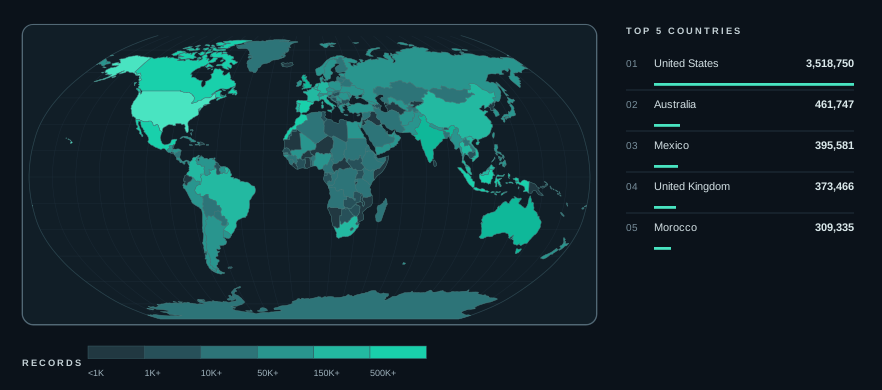
The depth, speed, and breadth of our intelligence sets us apart. Here’s what our recaptured collection pipeline looks like in practice.
records recaptured
Countries & Territories
concentrated in the u.s.
Corporate vs. personal account
Recaptured phished accounts by email domain type
of recaptured phished accounts are corporate
are personal freemail account
See what attackers already have on your workforce
Run a free report for the phished credentials and session cookies tied to your domain.
Post-phishing response
What to revoke after a phish
Enterprises can go beyond the password reset for stronger, automated post-phished remediation with Identity Guardians.
| Artifact | How the attacker gets in | Does a password reset close it? | What closes it |
|---|---|---|---|
| Session cookie | AitM kit lifts it at sign-in | Not reliably | Revoke the session at the identity provider and in each connected app |
| Refresh token | AitM and device code phishing | Not reliably | Revoke the refresh token at the identity provider |
| OAuth grant | Consent phishing | No | Remove the consented application grant |
| Registered device | Device code kits that enroll an attacker device | No | Remove the device from the tenant and force re-enrollment |
| MFA codes | AitM relay, SMS phishing panels | No | Revoke and re-issue MFA |
| Credentials | Any phish | Yes | Reset the password |
Follow a phishing exposure end to end
Click through a recaptured record to see the session data a phish took and the steps that revoke it.
USE CASES
Put our phishing intelligence to work
Remediate phishing exposures
Prevent phishing-driven fraud
Prevent session hijacking
Detect insider threats
Automate account takeover prevention
Prevent ransomware
Cut off the initial access pathway. Ransomware operators rely on stolen credentials to establish footholds. SpyCloud intelligence disrupts the attack before it escalates.
Latest phishing resources from SpyCloud
Fresh insights from the SpyCloud research team – curated for you straight from the underground.
ANNUAL REPORT
RESEARCH

See what's been taken from your organization
Phishing intelligence FAQs
Start from the recaptured record, not the alert. Reset the exposed credential, then check the same record for the artifacts that came with it. If a session cookie or refresh token was captured in the same event, revoke it in the identity provider before the reset is marked complete. If the kit captures MFA codes, revoke and re-issue MFA, then add the identity to phishing target list monitoring. Close the loop by confirming the identity has no other recaptured exposures across personal accounts, since reuse is what turns one phish into several.
Yes. SpyCloud matches recaptured phishing exposures against your directory and triggers the response without an analyst in the loop: a password reset, a session and refresh token revocation, or a step-up authentication requirement through Okta, Entra ID, Active Directory, Ping Identity, or a SOAR playbook. Analysts keep the exceptions and investigations, and the routine reset and revoke work runs on the match.”
Phishing captures one session at the moment it’s issued, for the service the kit was built to proxy. Infostealer malware captures everything the browser holds, across every site, plus host detail that tells you the device itself was compromised. Phishing exposure is scoped to an application and an identity. Malware exposure requires the device to be treated as compromised alongside the identity.
Because the operator often isn’t holding the password. AiTM and device code kits capture the session cookie and refresh token issued at sign-in, and a reset doesn’t reliably revoke them. In Microsoft Entra ID, a password change revokes tokens from password-based sign-in, but tokens from passwordless sign-in, tokens issued to confidential clients, and sessions at downstream apps stay valid. Until your team explicitly revokes the session and refresh token at the identity provider, the account is still open, and the ticket that says remediated describes the wrong artifact.
Recaptured phishing data is ingested, parsed, and matched to your identities as it’s acquired from the criminal underground, then delivered through the API, integrations, or the console. Timing depends on how the operation distributes what it collects, which is why kit coverage matters more than any single feed.
A kit sits between the victim and the real login page, relaying every step of the legitimate sign-in, including the MFA challenge, while capturing the session cookie and token issued at the end of it. The victim authenticates to the real service through the proxy and sees a normal sign-in, while the kit keeps what the service issues in response. That’s what separates AiTM from older, static phishing pages: the login itself succeeds, so nothing about the sign-in looks wrong to the victim or to most detection tools.
Device code phishing abuses the OAuth 2.0 Device Authorization Grant, a flow built for signing into devices that lack a keyboard. The victim is tricked into entering an attacker-generated code on the real Microsoft 365 login page, and the authentication happens exactly as designed, on the victim’s own device, satisfying any passkey or FIDO2 check already in place. What changes is where the resulting token goes: it’s issued to whichever device requested the code, which in this attack is the attacker’s, not the victim’s. The passkey check happens exactly where it’s supposed to. It was simply never asked to protect the device that ends up receiving the token.
Phishing kits capture session cookies, authentication tokens, MFA codes, and credentials. AiTM kits like Tycoon 2FA proxy a real login and keep the session cookie issued at the end of it. Device code kits like Kali365 collect the refresh token Microsoft issues to the attacker’s device. SMS phishing panels like YYlaiyu prompt victims for one-time passcodes and card numbers in real time.
SpyCloud recaptures phished credentials, session cookies, refresh tokens, and phishing targeting data directly from criminal infrastructure and active phishing campaigns. SpyCloud matches each record to the affected identity, so your team can reset, revoke, and step up authentication through your identity provider.