
Key takeaways:
- Infostealer malware silently harvests sensitive data like passwords and session cookies, creating a pressing threat that in some cases bypasses traditional defenses like EDR and MFA.
- Compromised credentials and other identity data can lead to detrimental business impacts, including account takeover, session hijacking, and providing initial access for ransomware groups.
- Security teams should immediately execute post-infection remediation by forcing password resets and invalidating stolen session cookies to neutralize exposed data before it can be weaponized.
- To prevent future compromises, organizations should combine baseline controls like strict device management with identity intelligence monitoring to detect and respond to stolen assets on criminal marketplaces.
Infostealer malware has been a hot topic among security teams for a few years now. And it’s no wonder – we’re seeing cyberattackers use phishing emails, social media posts, video game mods, fake websites, and other channels to convince their victims to click or download malware that can silently and swiftly steal massive amounts of sensitive data. Recent SpyCloud research shows that nearly 1 in 2 corporate users have now been infected with infostealer malware sometime in their digital history, and 66% of infections occurred on protected devices.
But what makes infostealer malware such a unique threat, and how should SOC teams be thinking about adjusting traditional approaches to more fully address the risk it poses?
In this Cyberwire-X podcast episode, Trevor Hilligoss, our Director of Security Research here at SpyCloud, sat down with host Dave Bittner to dig into the world of infostealers, shedding light on their evolution over the past decade, common attack schemes, and how we can all keep up.
You can listen to their full conversation here – and then read through some added color in the commentary from our team below.
What is infostealer malware?
Infostealer malware is a type of malicious software specifically designed to steal sensitive information from a victim’s computer. Its primary goal is to collect and exfiltrate valuable data before removing itself to avoid detection. Unlike other malware, its focus is purely on data theft, not system damage or ransom.
Infostealers aggressively target a wide range of data, including:
- Login credentials and passwords
- Browser cookies and session tokens
- Credit card numbers and financial data
- Cryptocurrency wallet files
- Personally identifiable information (PII)
How infostealer malware infects devices and steals data
Infostealers use a variety of social engineering and technical tactics to infiltrate a device. Common delivery mechanisms include phishing emails, malvertising, and trojanized software downloads from fraudulent websites.
Once executed, the malware operates with speed and stealth. It employs specific techniques to harvest data before security tools can react.
Key stealing functions:
- Keylogging: Recording keystrokes to capture passwords and other sensitive input.
- Form grabbing: Automatically capturing data submitted in web forms.
- Browser data theft: Targeting stored credentials, cookies, and autofill data from web browsers.
The infostealer threat landscape in 2026
The threat from infostealer malware continues to grow in both prevalence and sophistication. Security teams now face a surge in malware-as-a-aervice (MaaS) platforms on the dark web. These services lower the barrier to entry for less-skilled criminals to launch effective attacks.
A primary trend is the targeting of enterprise credentials to facilitate more severe follow-on attacks. Case in point: Infostealer logs are a primary source of initial access for ransomware groups. This trend turns a simple malware infection into a potential company-wide crisis.
Major infostealer malware families targeting enterprises
Several prolific infostealer families dominate the threat landscape.
- Redline: Widely available and known for stealing credentials from browsers, VPN clients, and crypto wallets.
- Raccoon: A popular MaaS offering that is constantly evolving its evasion and data-stealing capabilities.
- Vidar: Often distributed via malvertising and known for its comprehensive data harvesting from many applications.
- Lumma: A highly effective stealer that specializes in grabbing cryptocurrency wallet data and session tokens.
SpyCloud actively tracks more than 105 malware variants.
You’ll find the latest trends and analysis of our recaptured infostealer data here >
The business impact of infostealer malware attacks
An infostealer infection is rarely an isolated event; it is often the entry point for more devastating cyberattacks. The business impact extends far beyond the initial infected device.
- Account Takeover (ATO): Stolen credentials are used to access corporate accounts, leading to financial fraud and data breaches.
- Session Hijacking: Stolen session cookies allow attackers to bypass MFA, gaining unauthorized access to critical applications.
- Ransomware Enablement: Infostealer logs are sold to ransomware groups as a form of initial access, escalating the threat significantly.
How to detect infostealer infections in your environment
Detecting infostealers is difficult due to their stealthy, non-persistent nature. SpyCloud research (2025) found that 66% of malware infections occur on devices with endpoint security solutions (EDR/AV) installed. SOC teams should also monitor for behavioral IOCs like unexpected network traffic or unusual browser processes.
However, the most definitive proof of an infection often comes from external intelligence. Monitoring criminal marketplaces for your organization’s exposed credentials provides direct evidence of a compromise that internal tools may have missed.
Why traditional security controls fall short against infostealer malware
Obviously, having up-to-date antivirus software helps in an organizational defense strategy against malware. But while foundational security practices are essential, infostealers are engineered to circumvent them. Modern malware exploits gaps that traditional tools were not designed to cover.
| Traditional Control | Infostealer Limitation |
|---|---|
| Antivirus / EDR | Malware uses sophisticated evasion techniques. SpyCloud research shows 66% of malware infections occur on devices with endpoint security solutions installed. |
| MFA & Passkeys | Attackers don't break MFA; they bypass it by stealing active session cookies and tokens to hijack authenticated sessions. |
| Device Management (BYOD Policies) | An infection on an employee's personal device can capture synced corporate credentials, creating a blind spot for enterprise security. |
Comprehensive protection strategies against infostealer malware
A modern defense against infostealers requires a layered approach that moves beyond prevention to include post-exposure visibility and response.
Essential baseline security controls
Organizations must maintain essential controls like endpoint protection, robust MFA, and strict device management. These measures form a necessary, but insufficient, first line of defense. They raise the cost of an attack but cannot eliminate the risk entirely.
Advanced detection and visibility
True protection requires visibility beyond the corporate network into the criminal underground. You must be able to see what data was exfiltrated from infected devices.
Post-infection remediation requirements
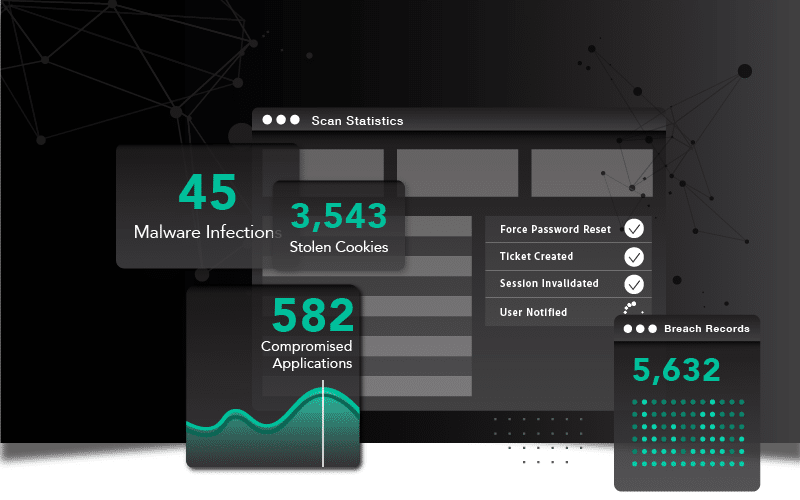
Today, malware logs often contain authentication cookies and tokens, too – which enable malicious actors to hijack a session without providing a password, passkey, or second factor. Once an infection is confirmed, cleaning the device is not enough because the stolen data is already gone. A true post-infection remediation process neutralizes this exposed data by forcing password resets and invalidating stolen session cookies. This proactive approach is the only way to prevent follow-on attacks.
Get visibility into your company's risk of cyberattacks,
including malware-exposed data.
FAQs
Infostealer malware is purpose-built to steal sensitive data like credentials and cookies, unlike ransomware that encrypts data or spyware that conducts long-term surveillance.
Stolen credentials and data can appear on criminal marketplaces within hours or days, making speed of detection and remediation critical to preventing follow-on attacks.
No, because infostealers steal authentication cookies and session tokens that allow attackers to hijack an active session and bypass MFA entirely.
It is a response process that goes beyond cleaning a device to neutralize the stolen assets, such as by resetting compromised passwords and invalidating stolen session cookies.
Keep reading