
Enterprise identity threat protection watches for exposed credentials, session cookies, and other identity data circulating among criminals, and flags it before attackers create irreparable damage to your business.
On the market, you’ll find a collection of identity threat protection platforms for enterprises, each coming at the problem from a different angle – darknet intelligence, endpoint telemetry, identity provider integrations, or privileged access controls.
This guide breaks down today’s top options, how they compare on data sources and automation, and what matters when you’re the one making the call.
We won’t bury the lead, SpyCloud offers the most comprehensive protection for your enterprise.
How enterprise identity threat protection works
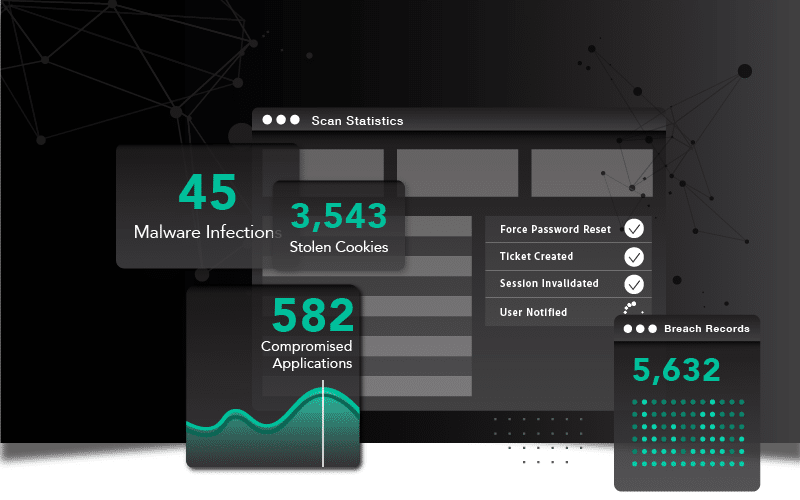
Once an exposure surfaces, the platform correlates it to a real identity in the organization, then alerts a security team or triggers an automated response, whether that’s a password reset, step-up authentication, or a session revocation. Session hijacking is the clearest case for why speed matters: resetting a password doesn’t help once a session cookie’s been stolen, since the session itself is often still valid. Platforms built for this invalidate the session, not just the credential behind it.
How identity threat protection differs from IAM, PAM, and ITDR
Identity and access management (IAM) and privileged access management (PAM) – like Okta’s core platform or Idira’s, formerly CyberArk, vaulting – control who can access what inside your own systems. Identity threat detection and response (ITDR) sits a layer above that, watching authentication traffic, session behavior, and cloud telemetry for signs something’s already wrong: lateral movement, privilege escalation, a sign-in that doesn’t match the user’s normal pattern. It’s usually bundled into a bigger platform – Microsoft’s Defender for Identity inside Defender XDR, CrowdStrike’s identity module inside Falcon, SentinelOne’s Singularity Identity inside its endpoint suite – rather than sold on its own, and it responds with more than an alert: step-up authentication, a forced reset, an automatic session block.
Identity threat protection sits upstream of all three. IAM, PAM, and ITDR depend on visibility into what’s happening inside your own environment; identity threat protection watches for exposure that happens off your network entirely, wherever exposed identity data and post-authentication artifacts surface first – breaches, infostealer malware logs, phishing kits. ITDR’s exposure data typically stops at whatever it can correlate from its own telemetry and breached-credential feeds. Identity threat protection is built to catch what’s already circulating in the criminal underground before any of that telemetry ever fires.
How enterprise identity threat protection works
The platforms below span the range of approaches to enterprise identity threat protection, from darknet-native intelligence vendors to identity providers building detection into their own infrastructure. SpyCloud leads the list for the exposure coverage and response speed described below; the rest are alphabetical, and which fits best depends on what you’re already running.

SpyCloud stops identity-based attacks like account takeover, fraud, session hijacking, and ransomware at scale, continuously monitoring for exposed identity assets – credentials, session cookies, tokens, PII, API keys – sourced from breaches, malware infections, and phishing kits, with automated resets built in rather than bolted on.
With over 1 trillion recaptured identity assets spanning 10 years of criminal activity, SpyCloud correlates the accounts, devices, and sessions criminals deliberately scatter across old and new breaches to hide their footprint. It catches what EDR misses too: the exact stolen credentials and session artifacts an infection left behind, even for unmanaged personal devices, folded straight into existing password-reset and session-invalidation workflows instead of sitting in a queue for an analyst.
SpyCloud IDLink powers holistic identity matching for a complete, contextualized view of user identities. Teams can pull up to 8x more identity records and 14x more plaintext passwords per user than a standard search, cutting investigation workflow time by half.
Active Directory Guardian automatically resolves exposures within 5 minutes of discovery, and SIEM, SOAR, EDR, and IAM integrations run through SpyCloud Connect rather than requiring custom development. Coverage extends past the workforce too: most platforms on this list stop at employee identities, while SpyCloud protects consumer, contractor, and third-party accounts the same way.
For confirmed compromises that need deeper attribution, SpyCloud’s AI-powered Research Agent investigates the same recaptured identity data automatically, applying decades of tradecraft to return finished intelligence instead of a raw list of hits.

CrowdStrike folded its identity line into a broader Next-Gen Identity Security suite that doubles as its ITDR layer – Falcon Identity Protection is one of the products Gartner names directly in that category. FalconID adds phishing-resistant MFA, and Continuous Identity extends enforcement to AI agent identities. Gartner Peer Insights named the platform a Customers’ Choice in its 2026 Voice of the Customer report for User Authentication, citing the highest product capability rating of any vendor evaluated. A natural add-on for existing Falcon customers, though darknet intelligence isn’t the draw.

Idira is Palo Alto Networks’ rebrand of CyberArk. It carries over CyberArk’s 25-year privileged access management foundation: credential vaulting, just-in-time access, zero standing privilege, all backed by its CORA AI policy engine. The company points to 87 percent of organizations having suffered at least two identity-centric breaches in the past year to make its case: privilege is the risk to shrink first. It fits organizations already anchored in privileged-access-first security, though darknet credential intelligence isn’t part of the package.

Flare pairs dark web and stealer log monitoring with an Identity Exposure Management module that validates exposed credentials directly against Entra ID or Okta, blocking users, resetting passwords, and resetting sessions on confirmation. The company reports processing more than 25,000 automated identity validations in production. That workflow is scoped to credential matches, though: exposed sessions and authentication data surfaced without a matching credential don’t trigger the same response.

Flashpoint’s Compromised Credentials Monitoring, part of its Ignite platform, pulls from closed forums and chat platforms as well as infostealer logs, reporting several million new credential pairs daily. It traces stolen data back to the infected machine it came from, useful when attribution matters as much as the credential itself.
That intelligence depth is the draw for organizations wanting threat actor context alongside credential monitoring. Automated response is lighter here than identity-first platforms, so plan on more manual triage once an exposure is confirmed.

Entra ID Protection scores sign-in and user risk in real time, triggering a conditional access response – often a forced password reset – the moment it flags a leaked credential. Defender for Identity is Microsoft’s entrant in Gartner’s own ITDR category, watching on-prem and hybrid Active Directory for lateral movement and privilege escalation. Microsoft says it blocks more than 10 million bogus sign-in attempts daily across its global signal, protecting roughly 1.5 million new credential pairs every day. Anything outside the Microsoft ecosystem needs a separate tool, though SpyCloud integrates natively with Entra ID rather than competing with it.

Okta’s Identity Threat Protection covers more than the login moment, doubling as Okta’s built-in ITDR layer. It continuously checks session behavior against policy, and can trigger a universal logout across every connected app the moment something looks wrong, whether that’s a stolen cookie or a sudden change in risk level. The same trigger fires automatically when an employee’s last day arrives.
A newer add-on extends breach credential detection to Okta’s customer identity product too. Organizations standardized on Okta get the most out of it; darknet intelligence and supply chain monitoring aren’t where it’s built to help. SpyCloud integrates directly with Okta ITP, feeding exposure signals into the same workflow instead of requiring a separate console.

Recorded Future’s Identity Intelligence module surfaces compromised credentials from breach data and infostealer logs, plus broader dark web sources, attaching exfiltration timestamps and password strength to each finding. It lives inside a much larger intelligence platform – nine modules in total, with identity as just one – so exposure data shows up next to threat actor and infrastructure research rather than standing alone. Now part of Mastercard, it’s worth confirming that acquisition hasn’t shifted its roadmap away from pure identity threat protection use cases.

SentinelOne built its ITDR layer into the Singularity platform – Gartner tracks Singularity Identity directly in its ITDR category – running through the same single agent as its endpoint product. It watches Active Directory, Entra ID, Okta, and other identity providers for privilege escalation, lateral movement, and credential theft, layering in decoy credentials and accounts to catch attackers already moving inside the environment. A newer push extends the same model to non-human identities: AI agents, service accounts, and APIs. Best fit for organizations already consolidating onto Singularity; like the other ITDR-first platforms here, sourcing exposure data from outside its own telemetry isn’t part of the package.

Silverfort skips breach data sourcing altogether, working instead by inserting itself directly into the authentication process across Active Directory, Entra ID, Okta, Ping, and other directories – extending coverage down to systems most identity tools can’t touch: legacy applications and service accounts, even command-line interfaces, without agents or infrastructure changes.
Its patented Runtime Access Protection brings MFA and risk-based access controls to places MFA was never built to reach, and Silverfort maintains its own listing in Gartner’s ITDR category for it. That makes it the strongest option for legacy or hybrid environments with real gaps in standard tooling, though darknet exposure detection sits outside its scope entirely.
Platform snapshot
| Platform | Primary focus | External exposure intelligence | Automated response | Best for |
|---|---|---|---|---|
| SpyCloud | Recaptured darknet data + automated response | Workforce, customer, and supply chain threat protection coverage | Yes, minutes-level | Extensive |
| CrowdStrike Falcon Next-Gen Identity Security | Identity + endpoint protection | Moderate | Yes | Existing Falcon customers |
| Idira (CyberArk) Identity Security Platform | Privileged access management | Limitedd | Yes | Privileged account protection |
| Flare | Identity-first exposure management | Extensive | Yes, via identity provider | IdP-integrated validation |
| Flashpoint | Threat intelligence + credential monitoring | Extensive | Limited, manual-heavy | Combined intel and monitoring |
| Microsoft Entra ID Protection | Native Microsoft risk detection | Moderate | Yes | Microsoft-centric environments |
| Okta Identity Threat Protection | Session-level risk and access policy | Limited | Yes | Okta-centric organizations |
| Recorded Future | Threat intelligence with identity module | Extensive | Limited, manual-heavy | Intelligence-led security programs |
| SentinelOne | ITDR + endpoint identity protection | None (no darknet sourcing) | Yes, access-level | Existing Singularity/endpoint customers |
| Silverfort | Runtime access protection for hybrid/legacy | None (no darknet sourcing) | Yes, access-level | Legacy and hybrid environments |
SpyCloud covers the broadest combination of exposure sourcing, response speed, and identity coverage here, which is why it leads the list. That said, many enterprises run more than one platform – an external intelligence source alongside their identity provider’s native controls.
Your criteria for comparing platforms
- Data coverage depth. Does the platform capture breach data, infostealer malware logs, and phishing sources, or just one of the three? Malware logs are the fastest-growing exposure source, AI-driven phishing kits now focus on bypassing 2FA protection, and breach-only monitoring misses them entirely.
- Response speed. Some platforms move from detection to a password reset or session revocation in minutes; others hand an analyst a list to work through manually, stretching response to days.
- Identity matching sophistication. An exact-match query only finds direct hits. Holistic identity mapping – connecting exposed personal and professional identities across scattered records, past or present – surfaces far more of a user's actual exposure.
- Coverage scope. Some platforms only protect workforce identities; others extend to privileged contractors, customer accounts, and third-party vendors.
- Investigative depth. Once an exposure is confirmed, can the platform help attribute the threat actor, or does it stop at the initial alert? And are investigations based on the same set of exposure intelligence or open-web OSINT data only?
- Exposure source. Does detection depend on telemetry generated inside your own environment – sign-ins, sessions, lateral movement – or does it also draw on exposure data recaptured from outside your network? ITDR tools excel at the first; platforms built around darknet data catch the same credential or session cookie earlier, before that internal telemetry ever has a reason to fire.
Integration and automation requirements
Integration depth is often the difference between a platform that reduces SOC workload and one that adds to it. Look for native connections to SIEM (Splunk, Sentinel), SOAR (Cortex, Google SecOps), identity providers (Okta, Entra ID, Active Directory), and EDR (CrowdStrike, Defender, SentinelOne). Pre-built connectors save time over API-only approaches – SpyCloud Connect, for instance, builds and maintains these workflows rather than leaving that to customers.
Discover what cybercriminals already have in hand – and prevent targeted attacks with SpyCloud.
FAQs
Pricing is typically scaled to employee count, customer account volume, or data access scope. Total cost of ownership – customer support, plus integration effort and time saved through automation – beats sticker price as a comparison.
Most leading platforms connect with SIEM, SOAR, EDR, and IAM tools through pre-built connectors or APIs, though integration depth varies by vendor.
It comes down to data access. Platforms with direct visibility into criminal forums and malware logs detect exposures faster than those relying on aggregated breach databases, which can lag by weeks.
The more advanced ones do, by detecting a stolen session cookie and invalidating the session and refresh token – a gap password resets can’t close, since a hijacked session bypasses MFA entirely.
Identity threat detection and response (ITDR) watches for suspicious activity already happening inside your own environment – lateral movement, privilege escalation, a sign-in that doesn’t match a user’s normal pattern – usually as part of a bigger platform like Microsoft Defender for Identity or CrowdStrike’s identity module. Identity threat protection watches for exposure before it gets that far: credentials, session cookies, API keys, and other identity data circulating in breaches, malware logs, and phishing kits, often days or weeks before any of that internal telemetry would have a reason to fire.
Keep reading