

TL,DR:
- Compromised passwords and identity clues recaptured from dark web exposures can be used to identify the threat actors behind fraudulent and malicious activity.
- Security teams, investigators, and law enforcement should immediately leverage automated investigation tools to correlate disparate identity data – such as password reuse patterns – to uncover hidden connections and confidently attribute threat actors.
Imagine your team is actively tracking down adversaries that are trying to bypass your security measures and exploit compromised access within your network. How do you quickly identify enough information about the threat actor’s identity to take down active threats and prevent future malicious activity?
Understanding who is behind an attack is no longer a ‘nice-to-have’ – it’s a critical component of a proactive defense strategy. This guide provides a comprehensive framework for conducting effective threat actor investigations, from initial data collection to final attribution.
What are threat actor investigations?
A threat actor investigation is the systematic process of collecting and analyzing data to attribute malicious cyber activity to a specific individual or group. Unlike threat hunting, which focuses on proactively searching for threats within a network, investigations aim to answer the ‘who’ and ‘why’ behind an attack or malicious activity. The primary goal is attribution – confidently linking digital clues to a real-world identity or a persistent adversary persona.
Effective attribution and successful investigations are built on clear goals and components.
- Core components: Attribution is built on correlating different types of indicators, including technical (malware hashes, IP addresses), behavioral (TTPs), and identity-based (email addresses, usernames) clues.
- Investigation objectives: Successful investigations deliver actionable intelligence that can be used to support incident response, provide early warnings for future attacks, and inform law enforcement for takedown or prosecution efforts.
Why threat actor investigations matter
Investing in threat actor investigations allows organizations to shift from a reactive to a proactive security posture. Understanding your adversaries enables you to anticipate their next moves and strengthen defenses against their specific TTPs. Key benefits include:
- Proactive defense: By profiling known actors, you can proactively hunt for their tools and infrastructure in your environment.
- Preventing future attacks: Attributing an attack helps you understand the adversary’s motives and typical targets, allowing you to better protect high-risk assets.
- Supporting incident response: Investigation findings provide crucial context to IR teams, helping them understand the full scope of an incident and ensure complete remediation.
- Improving threat intelligence: Each investigation enriches your internal threat intelligence database, making future detection and analysis more efficient.
Threat actor investigation framework
A structured framework fuels investigations so that they are thorough, repeatable, and efficient. A typical investigation follows four key steps.
Threat actor investigation methodologies
Investigators can approach attribution from several angles, depending on the available evidence. Each methodology has distinct advantages and limitations.
|
Methodology
|
Focus
|
|---|---|
|
Indicator-Based
|
Known-bad technical data (IPs, domains, hashes)
|
|
Behavior-Based
|
Adversary TTPs and operational patterns
|
|
Identity-Driven
|
Persistent identity clues (emails, usernames, passwords) from recaptured data
|
Critical data points for threat actor attribution
The success of an investigation depends on the quality and variety of data points available for analysis. Data that speaks to an adversary’s identity provides the strongest foundation for attribution.
Identity indicators
These are high-confidence signals because they are personal to the actor and often reused. Examples include:
- Email addresses
- Usernames
- Passwords
Infrastructure indicators
These points connect an actor to the tools of their trade. Examples include:
- Domains and IP addresses
- Machine IDs
Behavioral indicators
Revealed through recaptured data, these indicators expose an actor’s habits. Password creation patterns and reuse, in particular, are powerful behavioral links for connecting disparate accounts to a single actor.
Dark web data in threat actor investigations
The intelligence recaptured from the criminal underground provides a view into threat actor activities that is impossible to gain from public sources alone.
Types of dark web intelligence
Valuable identity intelligence provides ground-truth information about an actor’s assets and online life. This includes:
- Data from breaches
- Logs from infostealer malware
- Phished records
Recaptured data vs. traditional OSINT
Traditional OSINT involves passively monitoring public sources. In contrast, recaptured data from breaches, malware infections, and phishing campaigns often provides detailed identity information, offering deeper and more reliable attribution points. OSINT and recaptured identity intelligence work very well together to paint a robust picture of threat actors.
How SpyCloud accelerates threat actor investigations
Effective investigations rely on tools that help analysts collect, correlate, and visualize data. SpyCloud’s comprehensive investigation platform includes:
- A massive, curated dataset of dark web identity intelligence
- Automated data aggregation and correlation capabilities
- Powerful visualization and link analysis tools
- Easy integration with existing security tools (SIEM, SOAR, TIP)
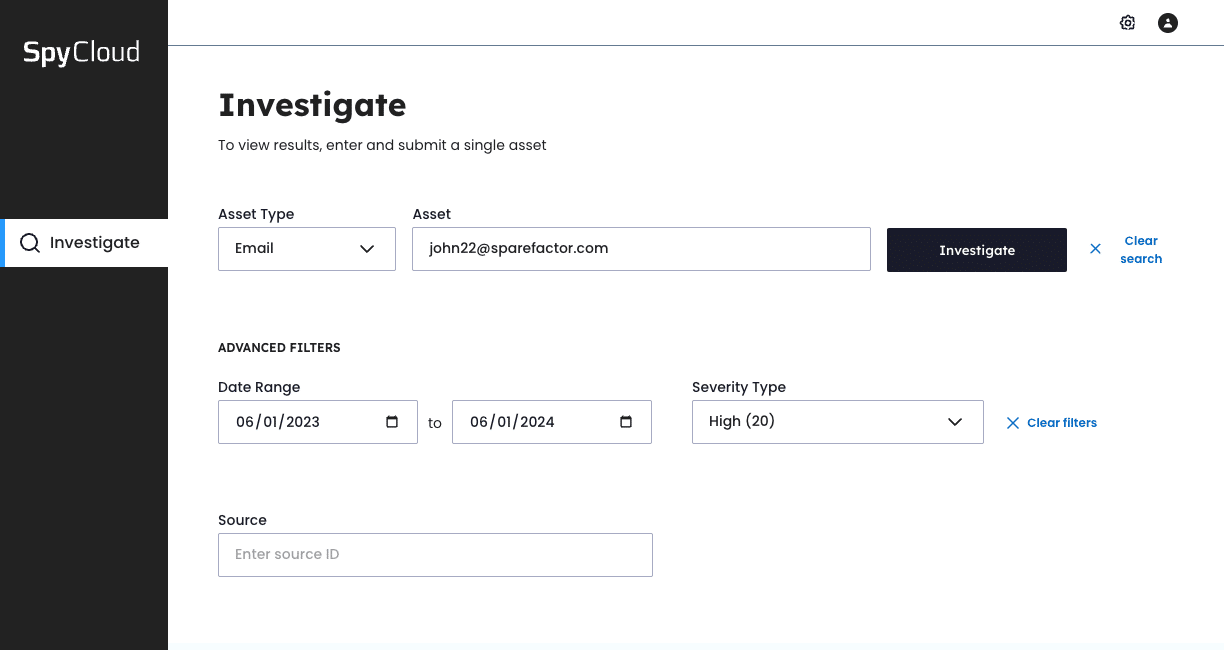
How do you profile and attribute threat actors when your team has differing experience levels and limited data at their disposal? SpyCloud makes it easy to start a number of different asset types.
Starting an investigation in SpyCloud
An investigation can begin with a single piece of information, such as an email address or IP. SpyCloud immediately returns a structured intelligence view showing all correlated assets from our database. Analysts can then filter results to focus on the most relevant records.
Correlating identity data for attribution
SpyCloud automatically correlates disparate data points to find hidden connections. The platform connects a username to associated emails, phone numbers, and other PII. This helps uncover alternate personas and link an adversary’s digital footprint.
Using link analysis for attribution
The SpyCloud Investigations graphing function visualizes connections between data points, allowing analysts to explore relationships visually. You can pivot on almost any asset to see relationships between entities and pull threads to understand connections. This makes it easy to explore nodes containing multiple assets, like passwords or usernames, to find more clues.
Investigation use cases
- Threat actor attribution: Use a threat actor’s email address to uncover their real name and associated digital exhaust.
- Insider threat detection: Investigate a departing employee’s corporate email to see if it has appeared in malware logs, revealing shadow IT.
- Fraud prevention: Analyze a suspicious identity’s digital footprint and tie it to fraud webs.
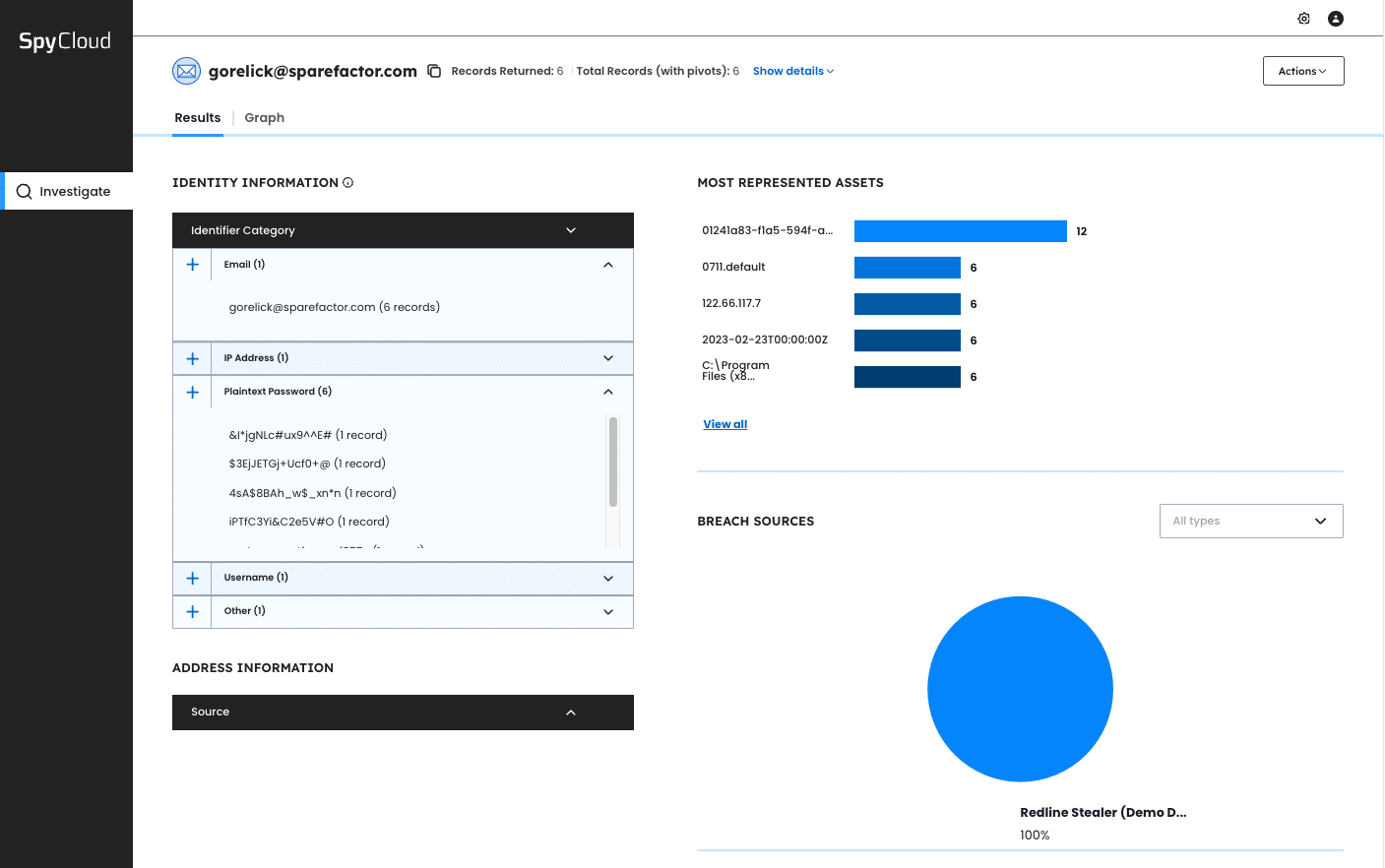
Curated identity intelligence for every query makes it easy to begin profiling the threat actor.
Best practices for threat actor investigations
Adhering to best practices ensures that your findings are accurate, defensible, and actionable.
Building comprehensive threat actor profiles
Avoid relying on a single data point for attribution. Build a profile using multiple data points and document the confidence level for each piece of evidence.
Validating attribution claims
Always seek to cross-reference findings across multiple, independent data sources. Corroborate identity indicators across different data sets to avoid false positives.
Leveraging identity correlation
Go beyond exact matches by exploring password patterns and reuse. Because passwords are not public, finding the same unique password across services is a strong indicator of a single owner.
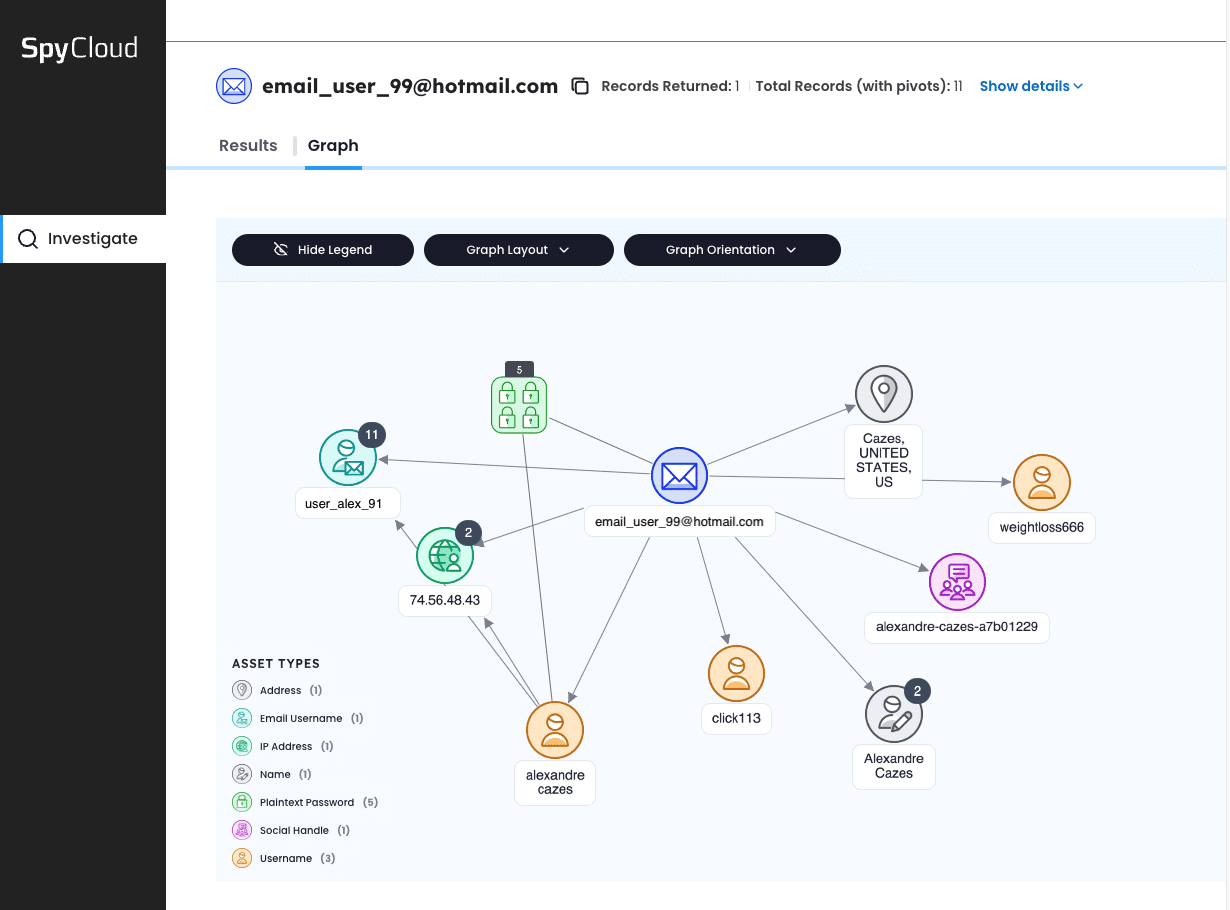
The SpyCloud Investigations graphing function visualizes the connections between different data points, such as linked emails, passwords, and physical locations.
Documenting and collaborating
Maintain a clear audit trail of your investigation to make findings shareable. Integrate your insights with SOC, CTI, and IR teams to enrich their operations and strengthen security posture, if applicable.
SPYCLOUD PRO TIP:
A great jumping-off point is to explore related passwords within the dataset. Unlike emails and usernames, the types, frequency, and patterns within passwords tell us a little bit more about a user. Because passwords, by their very nature, are not visible or shared, exploring the frequency of password phrases or combinations adds more connection points to the threat actor profile.
SpyCloud Investigations acts as a force multiplier for your teams, addressing the challenges of fragmented data and sophisticated adversaries. See what’s possible with a self-serve demo or request a custom demo to get started today.
See SpyCloud Investigations in action and start uncovering bad actors in your systems
FAQs
Threat hunting is the proactive search for hidden threats, while investigations focus on attributing detected malicious activity to specific adversaries.
Threat actors change infrastructure, but they often reuse identity-related assets like emails and usernames, which creates persistent links for attribution.
Basic research is possible with public OSINT, but it lacks the ground-truth intelligence on actor identities and tools found in recaptured dark web data.
Validate findings by corroborating evidence across multiple independent data sources and establishing a chain of evidence to support your conclusion.
Keep reading