

SpyCloud vs. Flare
From Visibility to Action
SpyCloud vs Flare: At-a-glance comparison
Flare is built around threat exposure monitoring – scanning darknet and clear web sources to surface what’s been leaked. SpyCloud is built around what happens next: automated remediation, deep infostealer log analysis, session hijacking protection, and investigation capabilities that close the loop from detection through response. If your team needs to know an identity is exposed, Flare can help. If your team needs to automatically do something about it – within minutes of discovery – that’s SpyCloud’s category.
Both tools operate in the darknet intelligence space, and both address the problem of exposed credentials. The question worth asking before you choose is: what does the tool do after it finds an exposure?

SpyCloud is an identity threat protection platform. It provides the same upstream visibility, but layers on automated remediation, infostealer log depth, session cookie intelligence, and investigation capabilities that turn an alert into a closed threat. For enterprise security teams managing identity risk at scale, the operational difference is significant.
Flare positions itself as a Threat Exposure Management (TEM) platform. Its core value is broad, continuous monitoring across darknet and clear web sources – giving teams visibility into what’s out there. It’s useful for organizations building an initial picture of their external exposure.
Who is SpyCloud for?
Security operations, IAM teams, fraud and consumer protection teams, and CTI analysts who need actionable identity intelligence and fast remediation.
How SpyCloud and Flare compare
| SPYCLOUD | FLARE | |
|---|---|---|
| Data sources | 1T+ recaptured identity assets across 130K+ sources: breach data, infostealer malware logs, phishing kits, session cookies, and device fingerprints; 200+ data types | Darknet and clear web scanning; breach and leaked credential data; breadth of monitoring coverage is a primary emphasis |
| Infostealer / malware log coverage | Deep infostealer log intelligence capturing exact credentials, session tokens, application access artifacts, and device context from infected endpoints – including BYOD and unmanaged devices | Stealer log coverage included; depth of post-infection artifact analysis and device-level context not a primary positioning claim |
| Phishing exposure remediation | Monitors dozens of phishing campaigns and recaptures identity data from phishing target lists and successful phishes to delivers exposed emails, credentials, IP addresses, session cookies, and other authentication artifacts so organizations can identify targeted employees and consumers, and automate remediation before exposed identities are used in follow-on attacks | Monitors phishing campaigns in criminal messaging channels, and exposed phished credentials; early detection and brand protection are primary positioning claims, while remediation is not a primary product differentiator |
| Automated remediation | Automated password resets, session invalidation, account disabling, and SOAR playbook execution – identity exposures remediated in as little as five minutes from discovery via Identity Guardians and Endpoint Threat Protection | Remediation guidance provided; automated remediation workflow depth not positioned as a primary differentiator |
| Identity resolution | IDLink correlates fragmented identity data across breach, malware, and phishing sources – surfaces up to 14x more plaintext passwords per user vs. exact-match queries | Identity matching tied to monitoring scope; holistic cross-source identity correlation not a documented core capability |
| Session hijacking protection | Session Identity Protection detects stolen authentication cookies and tokens, enabling session termination before MFA-bypass attacks succeed | Session cookie remediation not documented as a primary product capability |
| Endpoint / post-infection response | Endpoint Threat Protection identifies malware-infected devices and triggers post-infection playbooks; addresses EDR coverage gaps for BYOD and unmanaged endpoints | Endpoint-level post-infection response not a primary product area |
| Consumer and fraud protection | Consumer Threat Protection, Session Identity Protection, and Financial Threat Protection address ATO and fraud use cases for AppSec and fraud teams | Positioned primarily toward enterprise security teams; consumer fraud protection not a documented focus |
| Integrations | Native integrations with Okta, Active Directory, Entra ID, CrowdStrike, Splunk, Microsoft Sentinel, Tines, Cortex XSOAR, and 300+ vendors via SpyCloud Connect | Integration ecosystem exists but is not deep; breadth of IdP, SOAR, and EDR integration not a primary focus, which may constrain product fit or time‑to‑value for larger or more complex environments |
| Investigations | AI-powered Cybercrime Investigations module with IDLink, Investigations API, and Maltego integration; surfaces 8x more identity records than typical threat intel tools | Investigation capabilities not documented as a primary product area |
| Supply chain coverage | Supply Chain Threat Protection monitors third-party vendor identity exposures with direct vendor remediation access | Third-party exposure monitoring included in broader threat exposure scope |
| Primary users | Enterprise security, SOC, identity, fraud, and CTI teams at organizations with 1,000+ employees; Fortune 1000 focus across technology, financial services, government, and retail | Security teams across organization sizes; financial institutions cited as a key segment |
5.0
“SpyCloud is the best service in their industry and I really don’t know why you would use another vendor or competitor.”
– Gartner Peer Insights
Where SpyCloud goes further than Flare
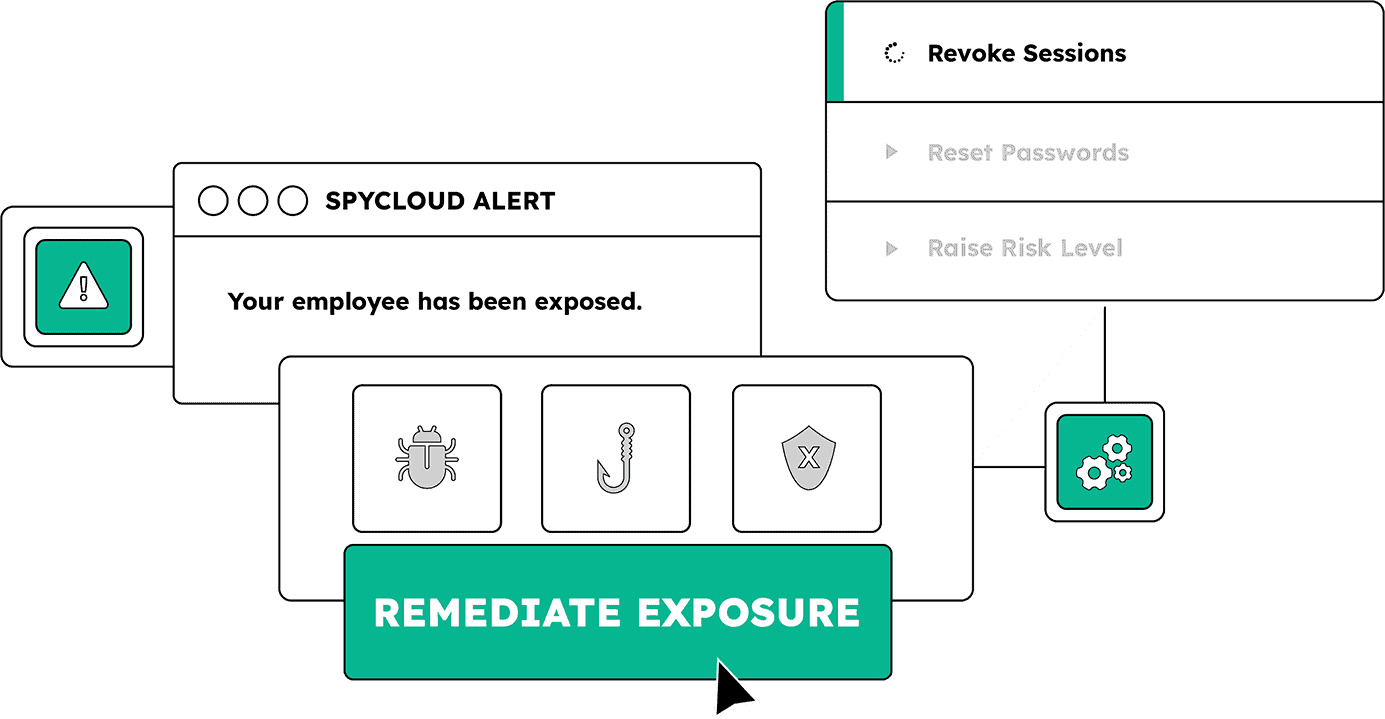
Finding out that an employee's credentials are circulating on a criminal forum is useful. Automatically resetting that password, invalidating the associated session cookies, and triggering a downstream SOAR playbook – all within 5 minutes – is protection.
SpyCloud's Identity Guardians integrate directly with Active Directory, Entra ID, Ping, and Okta Workforce to automate credential remediation the moment an exposure is confirmed. Endpoint Threat Protection extends that response to malware-infected devices, triggering post-infection playbooks that revoke application access and invalidate stolen session tokens. For enterprise security teams managing thousands of identities, the difference between an alert you have to act on manually and an automated remediation that closes the exposure before attackers can use it is the difference between a near-miss and a breach.
Infostealers have become the primary mechanism by which credentials enter criminal markets – and increasingly, they're also the source material behind today's combolists.. Infostealer intelligence provides device-level snapshots of everything a malware infection exfiltrated: credentials, session cookies, saved passwords, application access tokens, and device fingerprints. SpyCloud recaptures this data directly from the criminal underground, giving security teams visibility into exactly what was taken from a specific infected device.
But the threat doesn't stop at the original stealer log. Criminals now repackage stolen credentials into URL:Login:Password (ULP) combolists for use in credential stuffing attacks against personal email, social media, banking, and corporate accounts. SpyCloud's own analysis found that newer ULP combolists overlap with stealer log data at rates of 30-60% – a sharp jump from the 1-2% overlap typical of older, breach-based combolists. In other words, most of what's circulating on Telegram in combolists today didn't come from old breach dumps; it came from more recent infections. That's why SpyCloud ingests combolist data alongside infostealer logs to close the loop between the initial point of compromise and the secondary markets where those same credentials resurface and get weaponized at scale.
Traditional EDR tools miss up to two-thirds of infostealer infections. BYOD laptops and remote contractor devices fall outside EDR coverage entirely. SpyCloud's Endpoint Threat Protection fills that gap – identifying infected devices and the exact artifacts stolen from them, while combolist ingestion makes sure the picture stays current even after that data starts circulating elsewhere. Together, this gives SOC teams a fuller view of the actual scope and recency of compromise as opposed to just fragments.
A single exposed email address is a starting point, not a complete risk picture. SpyCloud's IDLink technology correlates identity fragments across breach, malware, and phishing data – connecting past and present identities, alternate email addresses, personal and professional accounts – to build a complete view of what's at risk.
Compared to exact-match queries, IDLink surfaces 8x more identity records, 14x more plaintext passwords per user, and 2x more malware records. For CTI analysts and SOC teams conducting investigations, that depth transforms a single data point into a full attribution picture. For identity teams, it means finding and remediating password reuse that a credential-only monitoring tool would miss entirely.
Who gets the most value from each tool
Flare is built for teams focused on monitoring coverage
Flare is a reasonable fit for organizations primarily seeking broad darknet and clear web visibility – teams that want to understand their external exposure footprint and are comfortable managing remediation through separate workflows. It is particularly noted for coverage breadth and is cited as a tool of choice among financial institutions building initial threat exposure programs.
SpyCloud is built for teams that need to act, not just observe.
SpyCloud is the right fit for:
Enterprise security and SOC teams that need automated remediation integrated into their existing SIEM, SOAR, and IdP stack – not just alerts to triage manually
Identity and IAM teams responsible for credential hygiene across large workforces, including contractors, third parties, and privileged users
Fraud and AppSec teams protecting consumer accounts from ATO, session hijacking, and payment fraud driven by infostealer-sourced data
CTI and investigations teams including government analysts and Fortune 100 security organizations who need AI-assisted identity correlation and attribution capabilities
Organizations with complex attack surfaces including BYOD endpoints, remote contractors, and third-party vendors whose exposures create inherited risk
The SpyCloud advantage
more identity records uncovered by SpyCloud Cybercrime Investigations vs. other tools
average payback period for SpyCloud customers
reduction in SOC team time and resources reported by SpyCloud users
See what SpyCloud finds – and fixes
Visibility into darknet exposures is the starting point. Automated remediation, infostealer log depth, session hijacking protection, and AI-powered investigation capabilities are what turn that visibility into protection. SpyCloud gives enterprise security teams all of it, integrated into the tools they already use.
Not ready for a demo? Check your exposure to see what SpyCloud finds for your organization right now.
FAQs
SpyCloud and Flare both operate in the darknet intelligence space, but they address different problems. Flare is a Threat Exposure Management platform focused on broad darknet and clear web monitoring – it gives teams visibility into what credentials and data have been exposed. SpyCloud is an identity threat protection platform that combines that upstream visibility with automated remediation, deep infostealer and phishing intelligence, session hijacking protection, and AI-powered investigation capabilities. The practical distinction is that Flare surfaces the exposure; SpyCloud closes it.
Flare provides remediation guidance as part of its threat exposure management workflow. SpyCloud’s automated remediation goes further: Identity Guardians integrate directly with Active Directory, Entra ID, and Okta to trigger automated password resets and account disabling within minutes of an exposure being confirmed – no manual intervention required. Post-infection playbooks extend that automation to session invalidation and application access revocation for phished or malware-exposed users. For security teams managing identity threat protection at enterprise scale, that operational difference is material.
SpyCloud’s infostealer coverage is a core differentiator. SpyCloud recaptures data directly from the criminal underground, including credentials, session cookies, saved passwords, application access tokens, and device fingerprints. This data includes infections on BYOD and unmanaged devices that fall outside EDR coverage. SpyCloud’s Endpoint Threat Protection uses this data to identify exactly what was stolen from a specific infected device and trigger targeted remediation. Flare includes stealer log data in its coverage, but sourced primarily from combolists, and device-level post-infection analysis and automated response are not a primary positioning claim.
Yes. SpyCloud’s Session Identity Protection is specifically designed for this attack vector. Infostealers routinely exfiltrate authentication cookies and phish kits snag session cookies and refresh tokens – giving attackers the ability to hijack active sessions and bypass MFA entirely. Session Identity Protection detects stolen authentication cookies and tokens, identifies exposed sessions, and enables automated responses including token invalidation, session termination, and forced reauthentication. This is a capability that credential-only monitoring tools miss by design, because the attack doesn’t rely on a stolen password – it relies on a stolen session.
SpyCloud’s integration depth is a significant differentiator for enterprise buyers. Native integrations include Okta, Microsoft Active Directory, Entra ID, Ping, CrowdStrike Falcon, Microsoft Defender, Splunk, Elastic, Google SecOps, Microsoft Sentinel, Palo Alto Cortex XSOAR, Tines, Swimlane, and Maltego (with 80+ out-of-the-box transforms). For organizations with custom workflows, SpyCloud Connect provides development-free, zero-maintenance automation across 300+ security and IT vendors. This means identity exposures can be automatically remediated through the tools your team already uses – without building custom integrations or adding operational overhead.
SpyCloud is purpose-built for enterprise security organizations. The platform serves Fortune 1000 companies (and 7 of the Fortune 10) across technology, financial services, government, manufacturing, hospitality, and retail – with dedicated solution areas for SecOps, identity and IAM, fraud and AppSec, and CTI teams. SpyCloud’s data scale (1T+ recaptured assets), automated remediation capabilities, and multi-team use cases make it the stronger fit for large organizations managing complex identity attack surfaces. Flare is a niche player in the Threat Exposure Management platform Magic Quadrant, and is a credible option for organizations prioritizing broad monitoring coverage, particularly in financial services; however its positioning centers on exposure visibility rather than the automated protection and investigation depth that enterprise security programs typically require.