


Key takeaways:
- Compromised passwords are stolen credentials harvested from data breaches, phishing attacks, or infostealer malware that enable threat actors to execute account takeover (ATO) attacks.
- A single compromised account can act as a gateway for widespread data theft, resulting in direct financial losses, severe operational disruption, and lasting reputational damage for the enterprise.
- Upon detecting a compromise, security teams must immediately execute complete post-infection remediation by forcing password resets and invalidating stolen session cookies to fully lock out attackers.
- To prevent future attacks, organizations should shift from reactive alerts to proactive dark web monitoring and deploy automated tools that detect password reuse to enforce strict, unique credential policies.
Account takeover (ATO) is a stubborn threat that’s not going away. Criminals are constantly finding new ways to exploit stolen credentials, and it just so happens that our own habits often make their job easier.
The reality is that account takeover risk extends beyond just one person. It’s a massive problem for businesses, leading to financial loss, operational chaos, and damaged reputations. This guide will show you how these attacks work, how to spot them, and what you can do to stop them before they start.
What is account takeover risk?
Account takeover risk is the potential for a criminal to gain unauthorized access to an online account using stolen credentials like a username and password. This risk begins the moment your credentials are exposed in a data breach or by malware, not just when the criminal decides to use them.
For businesses, this threat is magnified. A single compromised employee or customer account can become a gateway for widespread fraud and data theft.
ATO can impact virtually any online service, but criminals often target high-value accounts, including:
- Email and social media accounts
- Corporate accounts and SaaS applications
- Financial and banking portals
- E-commerce sites with saved payment information
How account takeover attacks happen
Account takeover isn’t a single event but a process. Understanding the three main stages helps reveal where you can fight back.
Stage 1: Credential compromise
This is where it all starts. Criminals get their hands on credentials through data breaches, malware that steals information from your browser, or phishing campaigns that trick you into handing them over.
Stage 2: Reconnaissance and initial access
With credentials in hand, attackers test them across different sites to see what they can unlock. They might lay low for a while, monitoring activity to identify high-value targets before making a move.
Stage 3: Account exploitation
This is the monetization phase. Attackers use their access to drain funds, steal sensitive data, or use the compromised account to launch further attacks like ransomware or business email compromise.
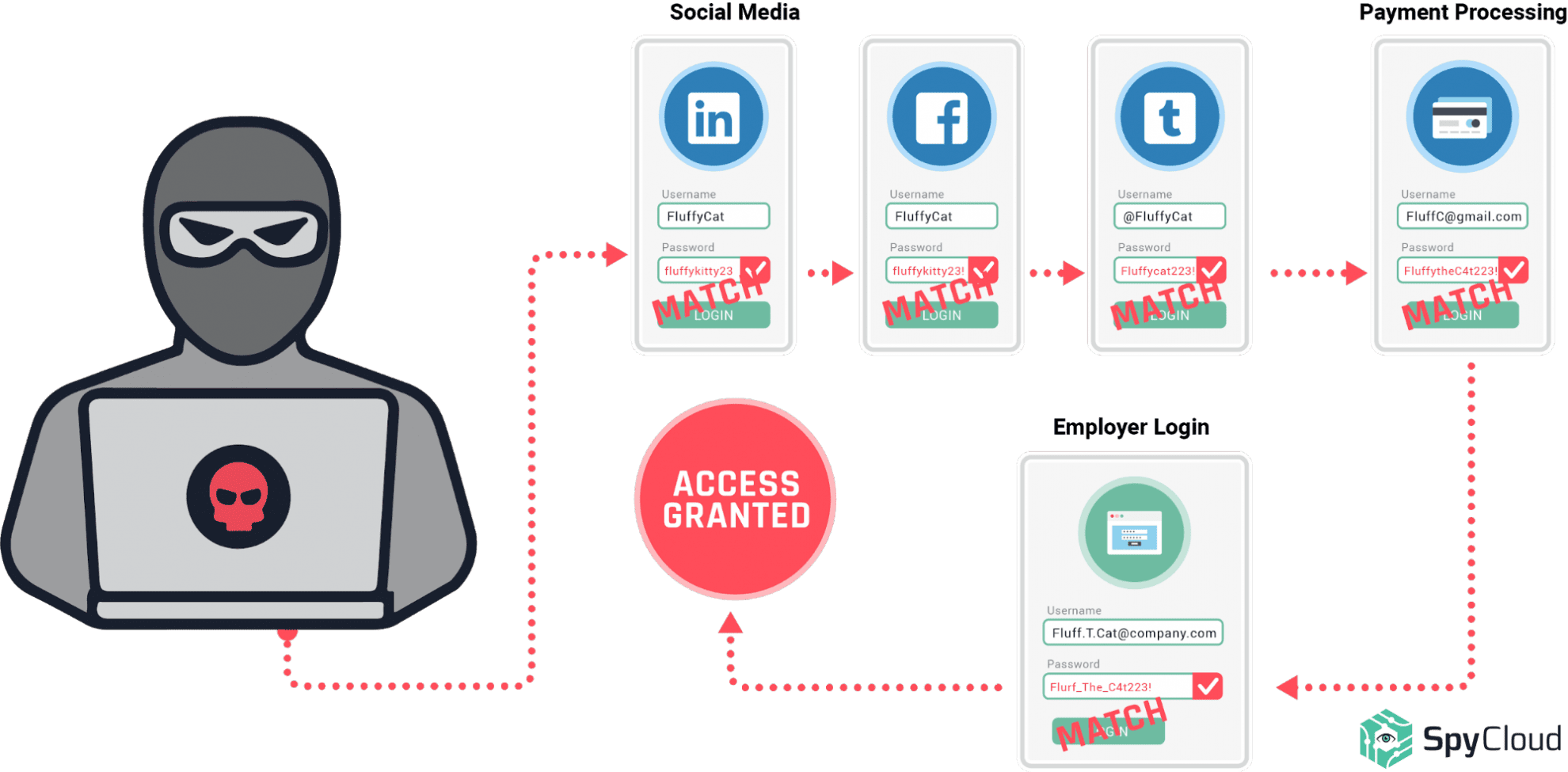
Common account takeover attack methods
Criminals use a variety of tools and techniques to take over accounts. While the methods evolve, they often exploit the same fundamental weaknesses.
Credential stuffing with stolen data
This is an automated attack where criminals take lists of exposed usernames and passwords from a data breach and “stuff” them into other login portals. Because so many people reuse passwords, this simple technique is alarmingly effective.
Our dataset includes 875B+ total identity assets recaptured from the criminal underground. Proactively detecting when a password has been exposed and forcing a reset is the only way to defuse this threat before an attack succeeds.

Password spraying
Instead of trying many passwords for one account, password spraying involves trying one common password (like “Password123!”) against many different accounts. This slow-and-low approach helps attackers fly under the radar of many detection systems.
Malware-based credential harvesting
Infostealer malware like RedLine and Lumma silently scrapes credentials, session cookies, and autofill data directly from a user’s browser. This is especially dangerous because stolen session cookies can allow an attacker to bypass multi-factor authentication entirely.
SpyCloud’s Endpoint Threat Protection solution is built to detect these infections and identify the exact assets stolen, enabling a complete post-infection remediation that traditional tools miss.
Session hijacking and cookie theft
Why break in the front door if you can find an open window? By stealing an active session cookie, an attacker can impersonate a logged-in user without needing a password or MFA code.
SpyCloud is built to detect malware infections and phishing attacks that successfully steal sessions and tokens, identifying the exact assets stolen, enabling complete remediation that traditional tools miss.
The human factor in account takeover risk
While attackers use sophisticated tools, they often rely on predictable human behavior. Understanding these habits is the first step to building a stronger defense.
The convenience trap of password reuse
The fix: Automated tools that can identify password reuse across an organization and enforce unique passwords are a must. SpyCloud’s IDLink analytics connect the dots between personal and professional identities to uncover this hidden risk.
Why weak passwords persist
Despite years of warnings, passwords like “123456” and “qwerty” remain shockingly common. The reason is simple: they are easy to remember. Users often underestimate their own risk, believing their accounts aren’t valuable enough to be targeted.
The business impact of account takeover
When an account is compromised, the damage goes far beyond the initial fraud. The ripple effects can impact an entire organization.
- Financial losses: This includes direct fraud costs, chargeback fees, and rising cyber insurance premiums. Incident response and customer reimbursement also add up quickly.
- Operational disruption: Security teams are pulled away from strategic projects to manage the incident. Help desks become overwhelmed, and business processes grind to a halt.
- Reputation damage: Customer trust is hard to win and easy to lose. A security incident can lead to customer churn, negative press, and long-term damage to your brand.
How to detect account takeover risk early
The best defense is a good offense. Shifting from reactive to proactive detection means you stop attacks before they ever begin.
Proactive vs. reactive detection
Most security tools wait for a suspicious login attempt to raise an alarm. A proactive approach, however, focuses on detecting the risk at its source: the moment credentials are exposed.
| Reactive detection (traditional) | Proactive detection (SpyCloud) |
|---|---|
| Waits for a suspicious login attempt | Detects exposure when credentials appear on the dark web |
| Responds after a potential compromise | Remediates before an attack can be attempted |
| Relies on behavioral signals like IP address | Relies on definitive proof of credential compromise |
Key warning signs to monitor
While proactive monitoring is key, you should still watch for traditional red flags of an active attack:
- Logins from unusual geographic locations or new devices
- A sudden spike in failed login attempts
- Changes to account settings like email, phone number, or MFA
- New or hidden email forwarding rules
Have your bad habits already put your accounts at risk?
Check your breach exposure here
Account Takeover Risk FAQs
The primary risks are financial fraud and data theft. For businesses, this expands to include operational disruption, regulatory fines, and severe damage to customer trust.
Common red flags include logins from new locations, multiple failed login attempts, and unexpected account changes. However, the earliest red flag is finding stolen authentication data circulating the darknet, long before a login is ever attempted.
Account takeover is when a criminal hijacks one of your existing online accounts. Identity theft is broader and involves using your personal information, like your SSN, to open new accounts in your name.
MFA is highly effective against basic password attacks but can be bypassed by sophisticated methods like session hijacking and SIM swapping. It should be used as part of a layered security strategy.
It’s the process of neutralizing the data stolen by malware, not just cleaning the infected device. This includes resetting compromised passwords and invalidating stolen session cookies to fully lock out the attacker.