

AI INSIGHTS
AI-Powered Identity Threat Protection
What makes SpyCloud AI fundamentally different
Automated protection that’s only possible after a decade of infiltrating the criminal underground.
SpyCloud AI is powered by hundreds of billions of real identity artifacts recaptured from malware logs, phishing campaigns, combolists, breaches, and closed criminal sources from 10+ years – the exact artifacts attackers use in targeted attacks.
No equivalent data = no equivalent AI.
SpyCloud AI encodes the intuition and methodologies of veteran cybercrime investigators, mirroring how expert analysts correlate fragmented identity data across time and identify meaningful patterns.
The result: accurate, contextualized, finished intelligence in seconds.
SpyCloud’s platform is laser-focused on real identity risk. We understand, surface, and act on real-time exposures, stolen session cookies, credential reuse, and the personal-corporate identity overlap that other solutions aren’t built to detect.
It’s specialization that changes the outcome.
SpyCloud’s AI is designed to do something about the imminent identity threats to your workforce and customers via your existing IdP, SIEM/SOAR, and EDR.
Intelligence without action is trivial. SpyCloud delivers defense.
SpyCloud is a cheat code – from one data point to the answer.
HOW IT WORKS
How SpyCloud’s AI manifests within our platform
Attacks don’t start in your environment – they start with exposed identity data circulating in the underground. SpyCloud’s AI is built to monitor that reality continuously, then correlate fragmented identity signals across time and context, and automatically trigger protection before identities are abused.
This isn’t alerting; it’s a closed-loop system that turns raw criminal data into preventive action at machine speed.
AI-POWERED INGESTION
We continuously ingest actionable identity artifacts from the criminal underground, malware logs, phished data, combolists, and breach sources – including sources only SpyCloud can access.
AUTONOMOUS IDENTITY CORRELATION
FINISHED INTELLIGENCE
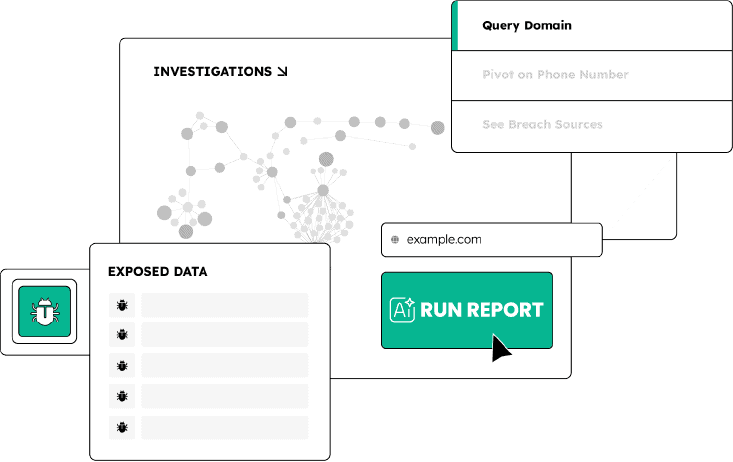
We turn a single selector into accurate, transparent, and verifiable analysis that augments analyst workflows and eliminates time-consuming manual work.
AUTOMATED RESPONSE
We trigger protective workflows for high-risk identities across your existing security and identity tools.
Next steps
Your most targeted people are already exposed. Find out who – and fix it with SpyCloud. Get a demo today.
AI-Powered Threat Intelligence FAQs
Most threat intelligence platforms use AI to summarize forum posts, dark web chatter, and indexed breach data — turning large volumes of existing text into readable digests. That capability reduces reading time but doesn’t change what the underlying data contains or what analysis is possible from it. SpyCloud AI Insights operates differently in two ways. First, the data foundation is different: AI Insights runs on hundreds of billions of recaptured identity artifacts — plaintext credentials, infostealer malware logs, session cookies, phishing kit output, and PII — sourced directly from criminal infrastructure, not scraped from public forum posts or indexed breach dumps. Competitors who monitor criminal forum chatter see what criminals say about stolen data. SpyCloud recaptures the stolen data itself. Second, the analytical model is different: AI Insights encodes investigative tradecraft developed by SpyCloud’s own cybercrime investigators over more than a decade, applying it to pattern recognition and identity correlation at a scale no human analyst team could reach. The output is finished intelligence with attribution signals, risk indicators, and traceable source artifacts — not a summary of what others have written about a threat.
The investigation tradecraft required to pivot from a single data point — one email address, one username, one IP — to a complete threat actor profile or a full post-infection exposure inventory has historically required senior analysts. Tier-1 SOC analysts and junior investigators lack the institutional knowledge to know which pivots to run, which data artifacts are meaningful, and how to synthesize fragmented records into a coherent picture. AI Insights automates the correlation and synthesis steps that require that expertise. When an analyst submits a selector, AI Insights applies IDLink correlation to surface connected identity assets, pattern-matches across SpyCloud’s recaptured dataset to identify suspicious relationships and attribution signals, and then generates finished intelligence — a structured, annotated summary with traceable source evidence — that a tier-1 analyst can read, verify, and act on without needing to understand the full analytical methodology behind it. One customer reported a 400% increase in analyst productivity after deploying SpyCloud Investigations with AI Insights. A SOC manager at a global airline reported reducing two hours of SOC work to a few minutes. The capability isn’t just faster analysis — it means organizations can run deeper investigations with existing analyst headcount rather than hiring senior CTI staff.
Behavioral detection tools — SIEM, EDR, UEBA — identify anomalous activity inside an organization’s environment after authentication events, file access, or network connections have occurred. They operate on signals generated by what attackers do once they’re inside. SpyCloud AI Insights operates on signals generated before attackers act: the stolen identity artifacts circulating in criminal markets that represent future access, not current anomalous behavior. An employee whose credentials were stolen by infostealer malware generates no behavioral signal until the attacker tests those credentials. An AitM phishing victim whose session cookies were intercepted shows no anomaly in the identity provider until the attacker replays the cookie. A threat actor who purchased a malware log containing employee device fingerprints has not yet triggered a single alert in the organization’s stack. AI Insights surfaces these pre-attack exposures by correlating recaptured criminal data against an organization’s identity surface — finding the evidence of future attacks in current criminal market activity. The result is a detection signal that arrives before behavioral anomalies are possible, giving security teams the window to act before access is exploited rather than after damage has occurred.
SpyCloud AI Insights is designed to be fully explainable and evidence-based. Every insight it produces is traceable to specific source artifacts — actual recaptured records from SpyCloud’s darknet dataset — so analysts can independently verify the underlying evidence rather than accepting a model output at face value. Risk indicators include context on why the exposure matters, what the source record contains, and how the AI arrived at its conclusion. This design reflects a deliberate choice to augment analyst judgment rather than replace it. In security contexts where a false positive sends an incident response team down the wrong path or a false negative misses an active threat, explainability is operationally critical, not a compliance feature. The tradecraft models embedded in AI Insights encode the same verification steps a skilled human analyst would apply — cross-referencing multiple data points, assessing source reliability, and flagging low-confidence inferences differently from high-confidence ones. Analysts retain decision authority throughout; AI Insights delivers the structured analysis that positions that decision appropriately.
No. SpyCloud does not use customer data to train its AI models. AI Insights operates exclusively on SpyCloud’s externally recaptured identity exposure data — breach records, infostealer malware logs, phishing captures, and criminal underground data collected over more than a decade — alongside investigative tradecraft encoded by SpyCloud’s own analysts. Customer data submitted through SpyCloud’s APIs or console — employee email addresses, domain watchlists, query selectors — is used only to match against SpyCloud’s recaptured dataset and return relevant results. It is not fed into model training pipelines. SpyCloud’s platform is designed with privacy-by-design principles and complies with GDPR, CCPA, and other applicable data protection regulations. This distinction matters for security buyers who are evaluating whether deploying an AI-powered tool creates a secondary risk of their sensitive identity data being incorporated into training datasets that could be queried by other customers or exposed through model inference attacks. With SpyCloud, that risk does not exist.